蚁 (yǐ) means "Ant" in Chinese. It has 9 strokes with the radical 虫.
Rated 4/5 in difficulty (challenging).
Appears in 3+ common words including 蚂蚁 (mǎ yǐ), 白蚁 (bái yǐ), 蚁穴 (yǐ xué).
Due to its 9 strokes, Hanzi Writer's error detection shows 蚁 requires focused practice — most learners need 10+ attempts for consistent accuracy.
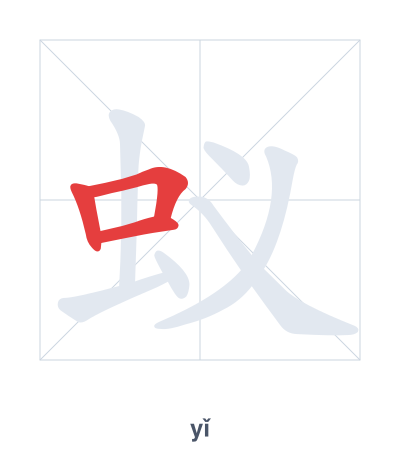
Open Hanzi Writer to see the animated stroke order and practice writing 蚁 with real-time feedback.
The character 蚁 (yǐ) is written with 9 strokes. Follow the standard Chinese stroke order: top to bottom, left to right, outside before inside. The radical 虫 is one of its key components.
Practice the correct stroke order with the Hanzi Writer app to see animated stroke-by-stroke guidance with real-time feedback.
蚁 means Ant.
蚁 is a phono-semantic compound. The left component 虫 (insect) indicates the meaning 'ant', while the right side 义 (yì) provides the pronunciation. Together, they create a character that visually represents an insect associated with a phonetic cue.
💡 Memory Tip: Picture a tiny ant (虫) marching proudly under a banner of justice (义), showing that even the smallest creature has a sense of duty.
蚂蚁在找食物。
mǎ yǐ zài zhǎo shí wù
The ants are looking for food.
白蚁吃了木头。
bái yǐ chī le mù tou
Termites ate the wood.
别踩那个蚁穴。
bié cǎi nà ge yǐ xué
Don't step on that anthill.
Open Hanzi Writer to see the animated stroke order and practice writing 蚁 with real-time feedback.
✨ Animated stroke order · Handwriting recognition · HSK-graded practice · Free to use
蚁 consists of the radical 虫 (insect) on the left and the phonetic component 义 (yì) on the right. The radical indicates it is related to insects, while 义 gives a clue to the pronunciation. Together, they form the character meaning 'ant'.