鹚 (cí) means "cormorant" in Chinese. It has 14 strokes with the radical 鸟.
Rated 4.2/5 in difficulty (advanced).
Appears in 3+ common words including 鸬鹚 (lú cí), 鸬鹚鸟 (lú cí niǎo), 养鸬鹚 (yǎng lú cí).
Due to its 14 strokes, Hanzi Writer's error detection shows 鹚 requires focused practice — most learners need 10+ attempts for consistent accuracy.
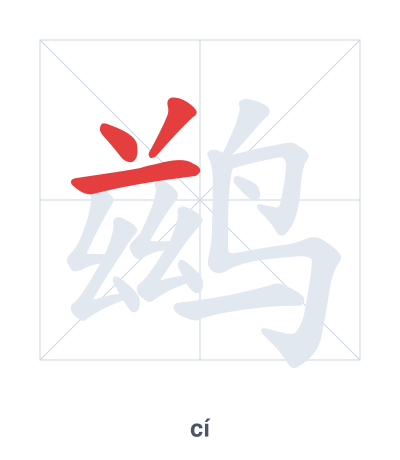
Open Hanzi Writer to see the animated stroke order and practice writing 鹚 with real-time feedback.
The character 鹚 (cí) is written with 14 strokes. Follow the standard Chinese stroke order: top to bottom, left to right, outside before inside. The radical 鸟 is one of its key components.
Practice the correct stroke order with the Hanzi Writer app to see animated stroke-by-stroke guidance with real-time feedback.
鹚 means cormorant.
鹚 is a phono-semantic compound, combining the radical 鸟 (bird) with 兹 as a phonetic component. The phonetic 兹 (originally depicting silk threads) hints at the pronunciation cí, while 鸟 indicates the cormorant is a bird. This character was created to specifically name the cormorant, a skilled fishing bird.
💡 Memory Tip: Picture a cormorant (鸟) diving underwater, its sleek body wrapped in silky tangled lines (兹) as it hunts for fish.
鸬鹚在船上站着。
lú cí zài chuán shàng zhàn zhe
The cormorant is standing on the boat.
鸬鹚鸟会帮人抓鱼。
lú cí niǎo huì bāng rén zhuā yú
Cormorant birds help people catch fish.
那个渔夫养鸬鹚。
nà ge yú fū yǎng lú cí
That fisherman keeps cormorants.
Open Hanzi Writer to see the animated stroke order and practice writing 鹚 with real-time feedback.
✨ Animated stroke order · Handwriting recognition · HSK-graded practice · Free to use
The character 鹚 is a phonetic-semantic compound. The left part 兹 provides the sound "cí", and the right radical 鸟 (bird) shows it is a type of bird. Together they represent the cormorant, a water bird known for fishing.