鹑 (chún) means "quail" in Chinese. It has 13 strokes with the radical 鸟.
Rated 4.2/5 in difficulty (advanced).
Appears in 3+ common words including 鹌鹑 (ān chún), 鹌鹑蛋 (ān chún dàn), 斗鹌鹑 (dòu ān chún).
Due to its 13 strokes, Hanzi Writer's error detection shows 鹑 requires focused practice — most learners need 10+ attempts for consistent accuracy.
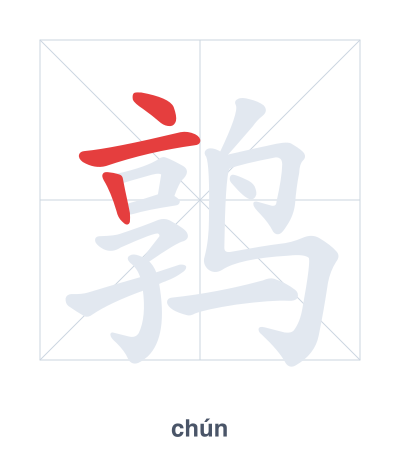
Open Hanzi Writer to see the animated stroke order and practice writing 鹑 with real-time feedback.
The character 鹑 (chún) is written with 13 strokes. Follow the standard Chinese stroke order: top to bottom, left to right, outside before inside. The radical 鸟 is one of its key components.
Practice the correct stroke order with the Hanzi Writer app to see animated stroke-by-stroke guidance with real-time feedback.
鹑 means quail.
鹑 is a phono-semantic compound: the left part 享 (xiǎng) indicates the pronunciation (chún), while the right part 鸟 (bird) signifies that it is a type of bird. In ancient times, quail were commonly hunted and enjoyed as food, linking the 'enjoy' component to the bird's culinary use.
💡 Memory Tip: Picture a quail (鸟) sitting on a plate, about to be enjoyed (享) at a feast—that's 鹑.
鹌鹑的蛋很小。
ān chún de dàn hěn xiǎo
Quail eggs are very small.
超市有卖鹌鹑蛋。
chāo shì yǒu mài ān chún dàn
The supermarket sells quail eggs.
古人喜欢斗鹌鹑。
gǔ rén xǐ huān dòu ān chún
Ancient people enjoyed quail fighting.
Open Hanzi Writer to see the animated stroke order and practice writing 鹑 with real-time feedback.
✨ Animated stroke order · Handwriting recognition · HSK-graded practice · Free to use
The character 鹑 is composed of the bird radical 鸟 on the right and the phonetic component 享 on the left. While 享 gives a clue to the pronunciation (chún), the bird radical indicates that the word refers to a type of bird, specifically a quail.