陲 (chuí) means "frontier or border" in Chinese. It has 10 strokes with the radical 阝.
Rated 3.9/5 in difficulty (challenging).
Appears in 3+ common words including 边陲 (biān chuí), 疆陲 (jiāng chuí), 陲远 (chuí yuǎn).
Due to its 10 strokes, Hanzi Writer's error detection shows 陲 requires focused practice — most learners need 10+ attempts for consistent accuracy.
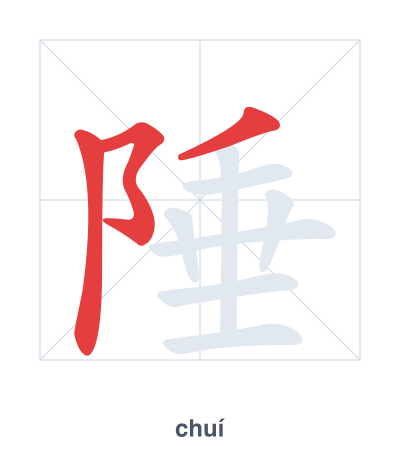
Open Hanzi Writer to see the animated stroke order and practice writing 陲 with real-time feedback.
The character 陲 (chuí) is written with 10 strokes. Follow the standard Chinese stroke order: top to bottom, left to right, outside before inside. The radical 阝 is one of its key components.
Practice the correct stroke order with the Hanzi Writer app to see animated stroke-by-stroke guidance with real-time feedback.
陲 means frontier or border.
陲 combines the radical 阝 (a hill or mound) with 垂 (to hang or droop). The character originally depicted a hill that forms a natural border, like a hanging cliff marking the frontier. Over time, 垂 itself came to mean 'border' and 陲 reinforced that meaning with the hill radical for a place concept.
💡 Memory Tip: Picture a frontier marked by a hill (阝) where a dangling rope (垂) hangs down to show where the border ends.
他在边陲小镇工作。
tā zài biān chuí xiǎo zhèn gōng zuò
He works in a remote border town.
这里的疆陲很美。
zhè lǐ de jiāng chuí hěn měi
The border regions here are very beautiful.
那个地方非常陲远。
nà ge dì fāng fēi cháng chuí yuǎn
That place is very far away on the frontier.
Open Hanzi Writer to see the animated stroke order and practice writing 陲 with real-time feedback.
✨ Animated stroke order · Handwriting recognition · HSK-graded practice · Free to use
陲 is composed of the radical 阝 (on the left), which means "hill" or "city wall," and the right part 垂 (chuí), meaning "to hang" or "to droop." Together, they suggest a place at the edge of a territory—like a hill or border that hangs on the frontier. This structure visually represents a remote boundary area.