嘼 (chù) means "livestock; beast" in Chinese. It has 15 strokes with the radical 口.
Rated 4.2/5 in difficulty (advanced).
Appears in 3+ common words including 嘼类 (chù lèi), 禽嘼 (qín chù), 嘼产 (chù chǎn).
Due to its 15 strokes, Hanzi Writer's error detection shows 嘼 requires focused practice — most learners need 10+ attempts for consistent accuracy.
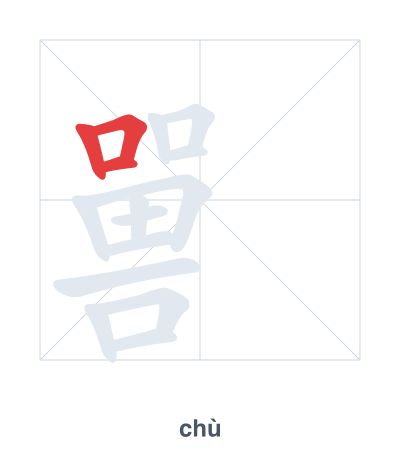
Open Hanzi Writer to see the animated stroke order and practice writing 嘼 with real-time feedback.
The character 嘼 (chù) is written with 15 strokes. Follow the standard Chinese stroke order: top to bottom, left to right, outside before inside. The radical 口 is one of its key components.
Practice the correct stroke order with the Hanzi Writer app to see animated stroke-by-stroke guidance with real-time feedback.
嘼 means livestock; beast.
嘼 is an ancient form of 畜 (livestock). It combines 口 (mouth or enclosure) and 單 (a hunting net or weapon), originally depicting an animal caught in a trap, later generalized to domesticated beasts.
💡 Memory Tip: Picture a beast trapped inside a square pen (口) with a net (單) over it — that's your livestock ready for market.
这里的嘼类很多。
zhè lǐ de chù lèi hěn duō
There are many kinds of animals here.
保护这些禽嘼。
bǎo hù zhè xiē qín chù
Protect these birds and beasts.
嘼产非常丰富。
chù chǎn fēi cháng fēng fù
Livestock products are very abundant.
Open Hanzi Writer to see the animated stroke order and practice writing 嘼 with real-time feedback.
✨ Animated stroke order · Handwriting recognition · HSK-graded practice · Free to use
嘼 is made of the radical 口 (mouth) on top and the component 畜 (chù, livestock) below. The 口 hints at animals as creatures that make sounds, while 畜 directly gives the meaning of livestock or beast. Together they form a character meaning 'livestock' or 'beast'.