谶 (chèn) means "prophecy; omen" in Chinese. It has 19 strokes with the radical 讠.
Rated 3.5/5 in difficulty (challenging).
Appears in 3+ common words including 谶语 (chèn yǔ), 灵谶 (líng chèn), 诗谶 (shī chèn).
Due to its 19 strokes, Hanzi Writer's error detection shows 谶 requires focused practice — most learners need 10+ attempts for consistent accuracy.
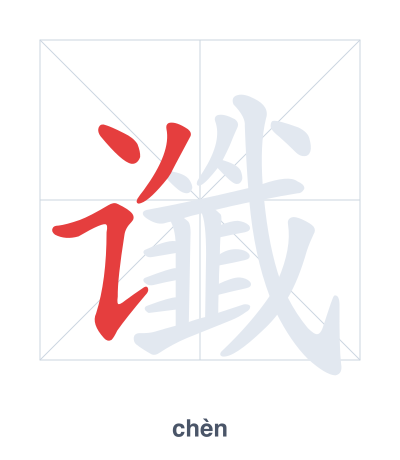
Open Hanzi Writer to see the animated stroke order and practice writing 谶 with real-time feedback.
The character 谶 (chèn) is written with 19 strokes. Follow the standard Chinese stroke order: top to bottom, left to right, outside before inside. The radical 讠 is one of its key components.
Practice the correct stroke order with the Hanzi Writer app to see animated stroke-by-stroke guidance with real-time feedback.
谶 means prophecy; omen.
谶 is a compound character formed with the speech radical 讠 and the phonetic component 韱 (xiān), which originally referred to prophetic writings or omens. The speech radical indicates that the word relates to spoken or written predictions, while 韱 adds the sound and connotation of something hidden or foretelling. This structure reflects how ancient Chinese prophecies were often recorded as cryptic texts or uttered by diviners.
💡 Memory Tip: Picture a prophet (讠) in a bamboo grove (竹) holding a dagger (戈) while uttering a dark prophecy of doom.
这句谶语应验了。
zhè jù chèn yǔ yìng yàn le
This prophecy has come true.
他说的话成了灵谶。
tā shuō de huà chéng le líng chèn
What he said became a prophecy.
诗谶往往很神秘。
shī chèn wǎng wǎng hěn shén mì
Prophetic poems are often very mysterious.
Open Hanzi Writer to see the animated stroke order and practice writing 谶 with real-time feedback.
✨ Animated stroke order · Handwriting recognition · HSK-graded practice · Free to use
The left side is the radical 讠 (speech), and the right side is 韱 (xiān, meaning "tiny" or "sharp"). Together, they suggest "words that are sharp or tiny"—like a hidden message or prophecy about the future. So 谶 means a prophecy or omen, often delivered through cryptic speech.