妓 (jì) means "Prostitute" in Chinese. It has 7 strokes with the radical 女.
Rated 3.5/5 in difficulty (challenging).
Appears in 3+ common words including 妓女 (jì nǚ), 歌妓 (gē jì), 艺妓 (yì jì).
Due to its 7 strokes, Hanzi Writer's error detection shows 妓 requires focused practice — most learners need 10+ attempts for consistent accuracy.
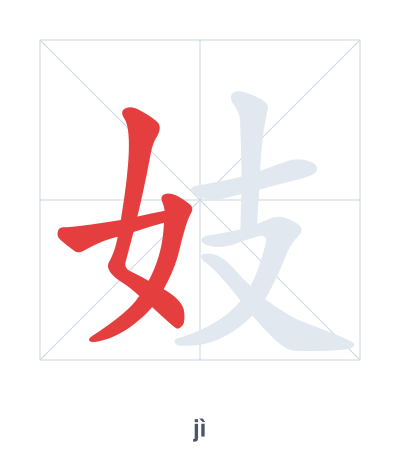
Open Hanzi Writer to see the animated stroke order and practice writing 妓 with real-time feedback.
The character 妓 (jì) is written with 7 strokes. Follow the standard Chinese stroke order: top to bottom, left to right, outside before inside. The radical 女 is one of its key components.
Practice the correct stroke order with the Hanzi Writer app to see animated stroke-by-stroke guidance with real-time feedback.
妓 means Prostitute.
This character is a phono-semantic compound: the radical 女 (woman) indicates gender, while 支 (zhī, meaning 'branch' or 'support') provides pronunciation and hints at a supporting role. Originally it referred to a female entertainer or singer, then gradually shifted to mean 'prostitute.'
💡 Memory Tip: Picture a woman (女) holding out a branch (支) like a sign, luring customers on a street corner.
这是一个妓女。
zhè shì yí gè jì nǚ
This is a prostitute.
古代有很多歌妓。
gǔ dài yǒu hěn duō gē jì
There were many singing girls in ancient times.
她是一名艺妓。
tā shì yī míng yì jì
She is a geisha.
Open Hanzi Writer to see the animated stroke order and practice writing 妓 with real-time feedback.
✨ Animated stroke order · Handwriting recognition · HSK-graded practice · Free to use
妓 is made of the radical 女 (woman) on the left and the phonetic component 支 (zhī, meaning branch or support) on the right. The 女 radical shows it relates to women, while 支 historically hints at a woman who sings or performs, connecting to the original meaning of female entertainer, which later shifted to prostitute.