饽 (bō) means "Bo (related to buns or pastries)" in Chinese. It has 10 strokes with the radical 饣.
Rated 4.2/5 in difficulty (advanced).
Appears in 3+ common words including 饽饽 (bō bō), 香饽饽 (xiāng bō bō), 蒸饽饽 (zhēng bō bō).
Due to its 10 strokes, Hanzi Writer's error detection shows 饽 requires focused practice — most learners need 10+ attempts for consistent accuracy.
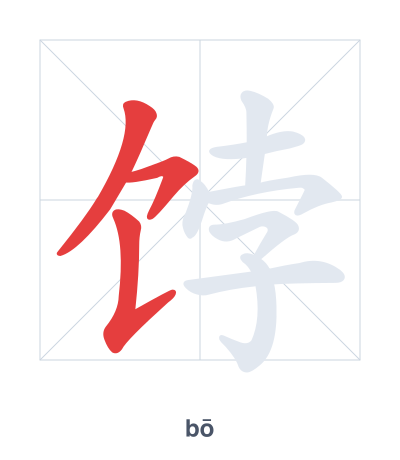
Open Hanzi Writer to see the animated stroke order and practice writing 饽 with real-time feedback.
The character 饽 (bō) is written with 10 strokes. Follow the standard Chinese stroke order: top to bottom, left to right, outside before inside. The radical 饣 is one of its key components.
Practice the correct stroke order with the Hanzi Writer app to see animated stroke-by-stroke guidance with real-time feedback.
饽 means Bo (related to buns or pastries).
The character 饽 combines the food radical 饣 (meaning 'eat' or 'food') with the phonetic component 孛 (bèi), which provides the sound bō. It was created during the Ming dynasty to write the word for a type of steamed bun or pastry, originally a regional term.
💡 Memory Tip: Picture a steaming bun (饣) with a twisted, comet-like knot on top (孛) that makes a 'bo' sound when you bite into it.
这个饽饽真软。
zhè ge bō bō zhēn ruǎn
This bun is really soft.
他在公司是香饽饽。
tā zài gōng sī shì xiāng bō bō
He is highly valued in the company.
妈妈在蒸饽饽。
mā mā zài zhēng bō bō
Mom is steaming corn cakes.
Open Hanzi Writer to see the animated stroke order and practice writing 饽 with real-time feedback.
✨ Animated stroke order · Handwriting recognition · HSK-graded practice · Free to use
饽 is composed of the food radical 饣 on the left and the phonetic component 孛 (bèi) on the right. The radical tells you that the character is related to food, while 孛 gives the approximate sound. Together they create a character for pastries or steamed buns.