恻 (cè) means "Sorrowful or pitying." in Chinese. It has 9 strokes with the radical 忄.
Rated 4/5 in difficulty (challenging).
Appears in 3+ common words including 恻隐 (cè yǐn), 凄恻 (qī cè), 恻然 (cè rán).
Due to its 9 strokes, Hanzi Writer's error detection shows 恻 requires focused practice — most learners need 10+ attempts for consistent accuracy.
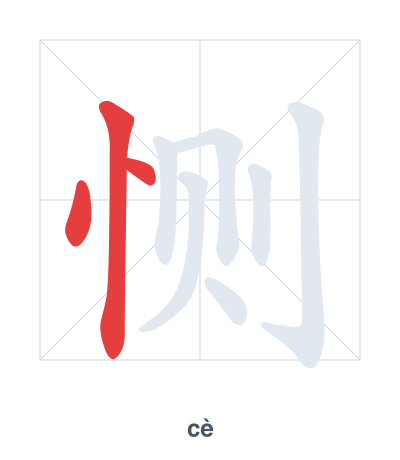
Open Hanzi Writer to see the animated stroke order and practice writing 恻 with real-time feedback.
The character 恻 (cè) is written with 9 strokes. Follow the standard Chinese stroke order: top to bottom, left to right, outside before inside. The radical 忄 is one of its key components.
Practice the correct stroke order with the Hanzi Writer app to see animated stroke-by-stroke guidance with real-time feedback.
恻 means Sorrowful or pitying..
恻 is a phono-semantic compound: the heart radical 忄 indicates emotion, and 则 (cè) provides the sound, while also hinting at 'cutting' (from its original meaning of carving rules into shells). Together, they evoke the sharp pang of sorrow or pity, as if the heart is cut by someone else's suffering.
💡 Memory Tip: Picture a heart (忄) being sliced by a knife (刂) over a treasure shell (贝) — the scene of loss triggers deep sorrow and pity.
他有恻隐之心。
tā yǒu cè yǐn zhī xīn
He has a heart of compassion.
琴声十分凄恻。
qín shēng shí fēn qī cè
The sound of the instrument is very sorrowful.
令人听了恻然。
lìng rén tīng le cè rán
It makes one feel sorrowful to hear it.
Open Hanzi Writer to see the animated stroke order and practice writing 恻 with real-time feedback.
✨ Animated stroke order · Handwriting recognition · HSK-graded practice · Free to use
恻 combines the heart radical 忄 on the left with 则 on the right. The heart radical shows that the character relates to emotions, while 则 gives the pronunciation cè. Together, they create the meaning of sorrow or pity felt in the heart.