摈 (bìn) means "to discard; to reject" in Chinese. It has 13 strokes with the radical 扌.
Rated 4.2/5 in difficulty (advanced).
Appears in 3+ common words including 摈弃 (bìn qì), 摈除 (bìn chú), 摈斥 (bìn chì).
Due to its 13 strokes, Hanzi Writer's error detection shows 摈 requires focused practice — most learners need 10+ attempts for consistent accuracy.
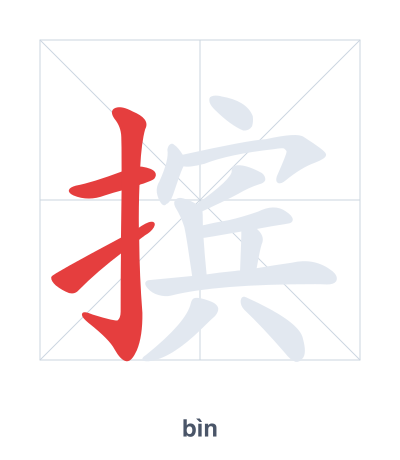
Open Hanzi Writer to see the animated stroke order and practice writing 摈 with real-time feedback.
The character 摈 (bìn) is written with 13 strokes. Follow the standard Chinese stroke order: top to bottom, left to right, outside before inside. The radical 扌 is one of its key components.
Practice the correct stroke order with the Hanzi Writer app to see animated stroke-by-stroke guidance with real-time feedback.
摈 means to discard; to reject.
The character 摈 combines the hand radical 扌 with 宾 (guest), suggesting the action of using one's hand to push away or dismiss a guest. This reflects its meaning 'to discard; to reject' as in expelling someone unwanted.
💡 Memory Tip: Picture a hand (扌) forcefully shoving a guest (宾) out the door—that's discarding them.
我们要摈弃坏习惯。
wǒ men yào bìn qì huài xí guàn
We must discard bad habits.
摈除脑子里的杂念。
bìn chú nǎo zi lǐ de zá niàn
Clear the distracting thoughts from your mind.
他被摈斥在集体之外。
tā bèi bìn chì zài jí tǐ zhī wài
He was excluded from the group.
Open Hanzi Writer to see the animated stroke order and practice writing 摈 with real-time feedback.
✨ Animated stroke order · Handwriting recognition · HSK-graded practice · Free to use
摈 combines the hand radical 扌 on the left with the phonetic component 宾 (bīn, guest) on the right. The hand radical indicates an action done with the hands, while the guest component hints at pushing away or dismissing a visitor, which connects to the meaning of discarding or rejecting.