筚 (bì) means "Wattle; bamboo fence" in Chinese. It has 12 strokes with the radical 竹.
Rated 4.2/5 in difficulty (advanced).
Appears in 3+ common words including 筚门 (bì mén), 筚路 (bì lù), 筚篥 (bì lì).
Due to its 12 strokes, Hanzi Writer's error detection shows 筚 requires focused practice — most learners need 10+ attempts for consistent accuracy.
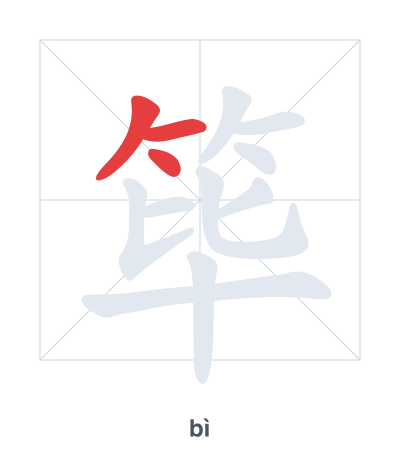
Open Hanzi Writer to see the animated stroke order and practice writing 筚 with real-time feedback.
The character 筚 (bì) is written with 12 strokes. Follow the standard Chinese stroke order: top to bottom, left to right, outside before inside. The radical 竹 is one of its key components.
Practice the correct stroke order with the Hanzi Writer app to see animated stroke-by-stroke guidance with real-time feedback.
筚 means Wattle; bamboo fence.
筚 combines the bamboo radical (竹) with the phonetic component 毕 (bì). It refers to a wattle fence or barrier woven from bamboo strips, a common ancient construction material.
💡 Memory Tip: Imagine a bamboo fence (竹) that a bee (sounds like 'bì') built by weaving strips together to protect its hive.
他家是筚门。
tā jiā shì bì mén
His family is of humble origins.
筚路蓝缕很辛苦。
bì lù lán lǚ hěn xīn kǔ
Starting an enterprise with great hardship is very difficult.
他会吹筚篥。
tā huì chuī bì lì
He can play the bili (a reed instrument).
Open Hanzi Writer to see the animated stroke order and practice writing 筚 with real-time feedback.
✨ Animated stroke order · Handwriting recognition · HSK-graded practice · Free to use
筚 combines the bamboo radical 竹 on top with 毕 (bì) below. The bamboo radical shows it is made from bamboo, while 毕 provides pronunciation. Together, they form the meaning of a wattle or bamboo fence, often used to describe a simple, humble home.