骜 (ào) means "Untamed horse or arrogant" in Chinese. It has 13 strokes with the radical 马.
Rated 4.2/5 in difficulty (advanced).
Appears in 3+ common words including 桀骜 (jié ào), 骜马 (ào mǎ), 桀骜不驯 (jié ào bù xùn).
Due to its 13 strokes, Hanzi Writer's error detection shows 骜 requires focused practice — most learners need 10+ attempts for consistent accuracy.
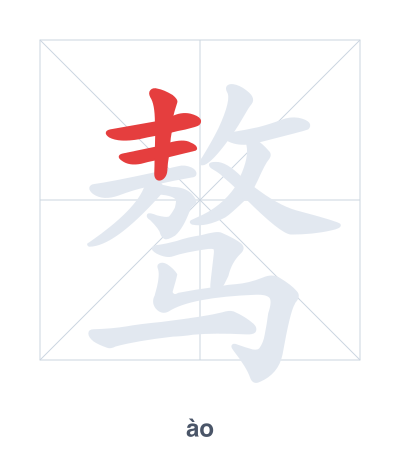
Open Hanzi Writer to see the animated stroke order and practice writing 骜 with real-time feedback.
The character 骜 (ào) is written with 13 strokes. Follow the standard Chinese stroke order: top to bottom, left to right, outside before inside. The radical 马 is one of its key components.
Practice the correct stroke order with the Hanzi Writer app to see animated stroke-by-stroke guidance with real-time feedback.
骜 means Untamed horse or arrogant.
骜 combines the radical 马 (horse) with 敖 (proud/wandering), which provides both sound and additional meaning. The horse radical indicates the animal, while 敖 suggests a wild, arrogant nature—together forming the idea of an untamed, spirited horse or an arrogant person.
💡 Memory Tip: Picture a horse with a spiky, rebellious mane (the top of 敖) that throws off its rider in defiance.
他的性格很桀骜。
tā de xìng gé hěn jié ào
He has a very stubborn and unruly character.
这是一匹骜马。
zhè shì yì pǐ ào mǎ
This is a wild steed.
那个少年桀骜不驯。
nà ge shào nián jié ào bù xùn
That youth is wild and unruly.
Open Hanzi Writer to see the animated stroke order and practice writing 骜 with real-time feedback.
✨ Animated stroke order · Handwriting recognition · HSK-graded practice · Free to use
骜 is composed of the radical 马 (horse) on the left and the phonetic component 敖 on the right. The radical gives the meaning related to horses, and the right part contributes the pronunciation ào. Together, they suggest an untamed horse, which leads to the extended meaning of being arrogant or unruly.