桀 (jié) means "cruel; name of a tyrant" in Chinese. It has 10 strokes with the radical 木.
Rated 4.2/5 in difficulty (advanced).
Appears in 3+ common words including 夏桀 (xià jié), 桀骜 (jié ào), 桀黠 (jié xiá).
Due to its 10 strokes, Hanzi Writer's error detection shows 桀 requires focused practice — most learners need 10+ attempts for consistent accuracy.
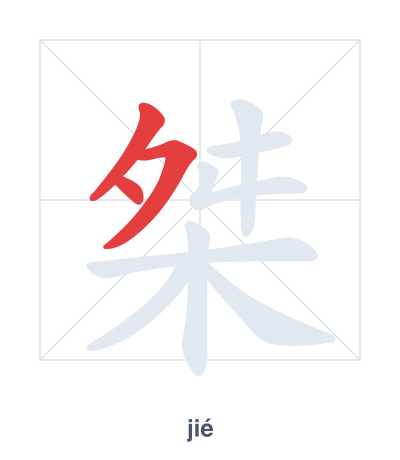
Open Hanzi Writer to see the animated stroke order and practice writing 桀 with real-time feedback.
The character 桀 (jié) is written with 10 strokes. Follow the standard Chinese stroke order: top to bottom, left to right, outside before inside. The radical 木 is one of its key components.
Practice the correct stroke order with the Hanzi Writer app to see animated stroke-by-stroke guidance with real-time feedback.
桀 means cruel; name of a tyrant.
The character 桀 originally depicted a person with two feet (舛) standing on a tree (木), symbolizing someone who climbs or tramples others. This image of dominance over nature was later associated with cruelty and the infamous tyrant King Jie of the Xia dynasty.
💡 Memory Tip: Picture the cruel tyrant Jie standing atop a tree (木) with his two feet (舛) crushing the branches beneath him.
夏桀是一个坏皇帝。
xià jié shì yí gè huài huáng dì
Jie of Xia was a bad emperor.
他的性格有点桀骜。
tā de xìng gé yǒu diǎn jié ào
He has a somewhat wild and unruly personality.
这个人非常桀黠。
zhè ge rén fēi cháng jié xiá
This person is very crafty and unruly.
Open Hanzi Writer to see the animated stroke order and practice writing 桀 with real-time feedback.
✨ Animated stroke order · Handwriting recognition · HSK-graded practice · Free to use
The character 桀 is composed of 舛 (two feet) on top and 木 (tree) below. The top part suggests opposition or disorder, and the bottom represents wood, together hinting at the character's meaning of cruelty or unruly behavior, though the original meaning may have been a perch.