谙 (ān) means "to know well; to be familiar with" in Chinese. It has 11 strokes with the radical 讠.
Rated 3.9/5 in difficulty (challenging).
Appears in 3+ common words including 谙熟 (ān shú), 深谙 (shēn ān), 熟谙 (shú ān).
Due to its 11 strokes, Hanzi Writer's error detection shows 谙 requires focused practice — most learners need 10+ attempts for consistent accuracy.
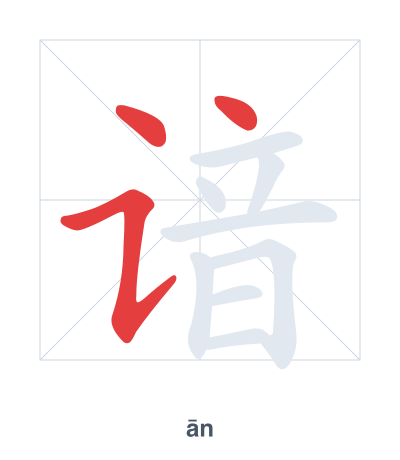
Open Hanzi Writer to see the animated stroke order and practice writing 谙 with real-time feedback.
The character 谙 (ān) is written with 11 strokes. Follow the standard Chinese stroke order: top to bottom, left to right, outside before inside. The radical 讠 is one of its key components.
Practice the correct stroke order with the Hanzi Writer app to see animated stroke-by-stroke guidance with real-time feedback.
谙 means to know well; to be familiar with.
谙 is a phono-semantic compound formed from the radical 讠 (speech) and the phonetic component 音 (yīn, meaning 'sound'). Together, they suggest knowing something well through repeated hearing and speaking, hence 'to know well' or 'to be familiar with.'
💡 Memory Tip: Imagine someone saying 'I know that sound (音) by heart' while pointing to their ear next to speech (讠).
他谙熟这里的路。
tā ān shú zhè lǐ de lù
He is very familiar with the roads here.
他深谙此道。
tā shēn ān cǐ dào
He is well-versed in this field.
他熟谙法律。
tā shú ān fǎ lǜ
He is well-versed in the law.
Open Hanzi Writer to see the animated stroke order and practice writing 谙 with real-time feedback.
✨ Animated stroke order · Handwriting recognition · HSK-graded practice · Free to use
The character 谙 combines the radical 讠 (speech or words) on the left with 音 (sound or music) on the right. The speech radical suggests language, while 音 hints at something that requires careful listening or deep knowledge, together implying "to know well" through sound and words.