嗯 (ńg/ǹg) means "Um, okay, or yes." in Chinese. It has 13 strokes with the radical 口.
Rated 4.2/5 in difficulty (advanced).
Appears in 1+ common words including 嗯 (ńg).
Due to its 13 strokes, Hanzi Writer's error detection shows 嗯 requires focused practice — most learners need 10+ attempts for consistent accuracy.
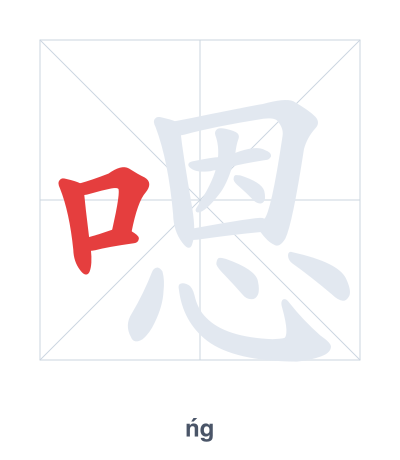
Open Hanzi Writer to see the animated stroke order and practice writing 嗯 with real-time feedback.
The character 嗯 (ńg/ǹg) is written with 13 strokes. Follow the standard Chinese stroke order: top to bottom, left to right, outside before inside. The radical 口 is one of its key components.
Practice the correct stroke order with the Hanzi Writer app to see animated stroke-by-stroke guidance with real-time feedback.
嗯 means Um, okay, or yes..
This is a polyphonic character with readings: ńg, ǹg.
嗯 is a semantic-phonetic compound. The radical 口 (mouth) indicates the character relates to speech or sounds, while 恩 (ēn, meaning 'grace' or 'favor') provides the phonetic component and hints at a polite, affirmative response. Together, the character graphically represents the vocalized sound of agreement or hesitation, like saying 'um' or 'okay.'
💡 Memory Tip: Picture a mouth (口) hesitantly saying 'um' while pondering a favor (恩) before reluctantly agreeing.
嗯?你说什么?
ńg nǐ shuō shén me
Huh? What did you say?
嗯,就这样吧。
ǹg jiù zhè yàng ba
Okay, let's leave it at that.
Open Hanzi Writer to see the animated stroke order and practice writing 嗯 with real-time feedback.
✨ Animated stroke order · Handwriting recognition · HSK-graded practice · Free to use
嗯 is formed by the radical 口 (mouth) on the left and 恩 (ēn, kindness) on the right. The mouth radical indicates that this character represents a sound or utterance, which matches its use as an interjection like “um” or “yes.”