卒 (zú) means "soldier; to die; to finish" in Chinese. It has 8 strokes with the radical 十, and is HSK Level 7.
Rated 3.4/5 in difficulty (challenging).
Harder than 13% of HSK Level 7 characters.
Appears in 3+ common words including 卒 (zú), 士卒 (shì zú), 兵卒 (bīng zú).
Due to its 8 strokes, Hanzi Writer's error detection shows 卒 requires focused practice — most learners need 10+ attempts for consistent accuracy.
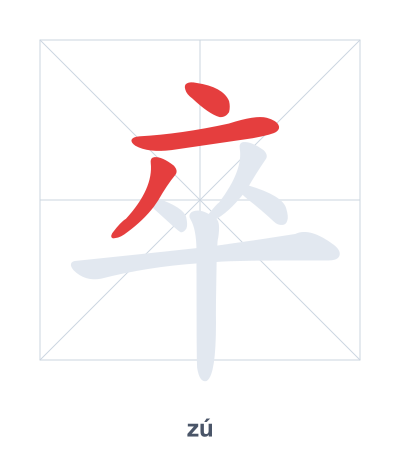
Open Hanzi Writer to see the animated stroke order and practice writing 卒 with real-time feedback.
The character 卒 (zú) is written with 8 strokes. Follow the standard Chinese stroke order: top to bottom, left to right, outside before inside. The radical 十 is one of its key components.
Practice the correct stroke order with the Hanzi Writer app to see animated stroke-by-stroke guidance with real-time feedback.
卒 means soldier; to die; to finish.
As an HSK Level 7 character, 卒 is an intermediate-level character.
The character 卒 originally depicted a garment with a cross mark, representing a soldier's uniform or a servant's robe. Over time, it came to mean 'soldier,' and by extension, 'to die' (as a soldier's fate) and 'to finish' (as in the end of a task or life). The modern form combines a top element 亠 (like a helmet) with a crossed structure below, suggesting a warrior's stance.
💡 Memory Tip: Picture a soldier wearing a helmet (top dot) with two crossed arms (middle lines) and a firm stance (bottom 十), ready to finish his duty or face death.
棋盘上有一个卒。
qí pán shàng yǒu yí gè zú
There is a pawn on the chessboard.
这里的士卒很勇敢。
zhè lǐ dī shì zú hěn yǒng gǎn
The soldiers here are very brave.
兵卒们正在训练。
bīng zú men zhèng zài xùn liàn
The soldiers are training.
Open Hanzi Writer to see the animated stroke order and practice writing 卒 with real-time feedback.
✨ Animated stroke order · Handwriting recognition · HSK-graded practice · Free to use
The character 卒 is composed of a top cover (亠), two people (从), and the radical ten (十). This structure suggests a group of soldiers under a banner or in a unit, which connects to the meaning "soldier." The bottom radical 十 also hints at the idea of a complete group or finishing, tying to the meanings "to die" and "to finish."