卉 (huì) means "plants; vegetation" in Chinese. It has 5 strokes with the radical 十, and is HSK Level 7.
Rated 2.7/5 in difficulty (moderate).
Harder than 4% of HSK Level 7 characters.
Appears in 3+ common words including 花卉 (huā huì), 卉木 (huì mù), 奇卉 (qí huì).
Hanzi Writer's stroke validation shows learners typically need 5-8 attempts to write 卉 with correct proportion and order.
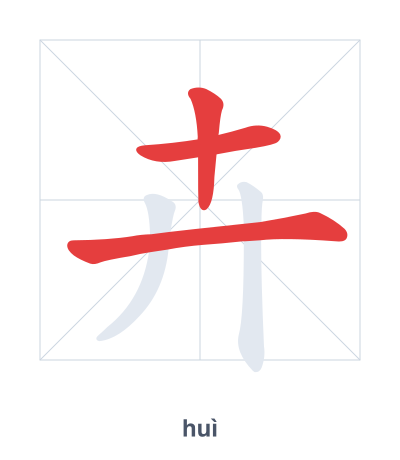
Open Hanzi Writer to see the animated stroke order and practice writing 卉 with real-time feedback.
The character 卉 (huì) is written with 5 strokes. Follow the standard Chinese stroke order: top to bottom, left to right, outside before inside. The radical 十 is one of its key components.
Practice the correct stroke order with the Hanzi Writer app to see animated stroke-by-stroke guidance with real-time feedback.
卉 means plants; vegetation.
As an HSK Level 7 character, 卉 is an intermediate-level character.
Originally a pictograph of three grass sprouts or stems emerging from the ground, the character 卉 depicted a cluster of vegetation. Its modern form retains this sense through three components resembling the radical 'ten' (十), suggesting multiple plants growing together.
💡 Memory Tip: Picture three 'ten' (十) signs as little plants with ten leaves each, sprouting side by side in a garden.
这里有很多花卉。
zhè lǐ yǒu hěn duō huā huì
There are many flowers here.
公园里卉木茂盛。
gōng yuán lǐ huì mù mào shèng
The plants and trees in the park are lush.
这种奇卉非常少见。
zhè zhǒng qí huì fēi cháng shǎo jiàn
This rare flower is very uncommon.
Open Hanzi Writer to see the animated stroke order and practice writing 卉 with real-time feedback.
✨ Animated stroke order · Handwriting recognition · HSK-graded practice · Free to use
卉 is composed of the radical 十 (ten) on top, which often means 'many' or 'complete,' and 廾 (two hands) underneath, but in its simplified form it looks like two stems or leaves. Together, they suggest many plants growing from the ground, fitting the meaning of 'vegetation.'