鲻 (zī) means "Mullet" in Chinese. It has 16 strokes with the radical 鱼.
Rated 4.2/5 in difficulty (advanced).
Appears in 3+ common words including 鲻鱼 (zī yú), 捕鲻 (bǔ zī), 鲻鱼头 (zī yú tóu).
Due to its 16 strokes, Hanzi Writer's error detection shows 鲻 requires focused practice — most learners need 10+ attempts for consistent accuracy.
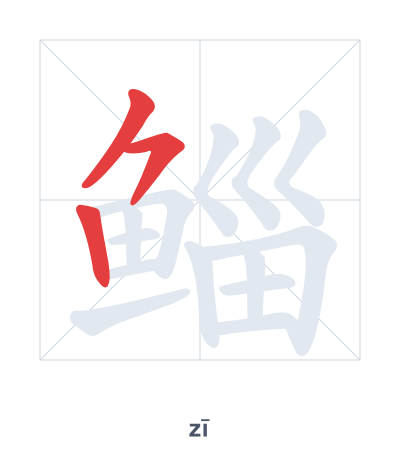
Open Hanzi Writer to see the animated stroke order and practice writing 鲻 with real-time feedback.
The character 鲻 (zī) is written with 16 strokes. Follow the standard Chinese stroke order: top to bottom, left to right, outside before inside. The radical 鱼 is one of its key components.
Practice the correct stroke order with the Hanzi Writer app to see animated stroke-by-stroke guidance with real-time feedback.
鲻 means Mullet.
鲻 is a phono-semantic compound. The radical 鱼 (fish) indicates it is a type of fish, while the component 兹 (zī) provides the pronunciation. This character specifically refers to the mullet, a common coastal fish.
💡 Memory Tip: Picture a fish (鱼) with a curly mustache (the top of 兹) saying, 'This (兹) is a mullet!'
鲻鱼在海边很常见。
zī yú zài hǎi biān hěn cháng jiàn
Mullet are very common at the seaside.
渔民们正在海里捕鲻。
yú mín men zhèng zài hǎi lǐ bǔ zī
Fishermen are catching mullet in the sea.
这种发型叫鲻鱼头。
zhè zhǒng fà xíng jiào zī yú tóu
This hairstyle is called a mullet.
Open Hanzi Writer to see the animated stroke order and practice writing 鲻 with real-time feedback.
✨ Animated stroke order · Handwriting recognition · HSK-graded practice · Free to use
The left side is 鱼 (fish radical), showing this character is a type of fish. The right side is 兹 (zī), which gives the character its pronunciation and originally meant "this" or "now". So 鲻 is a fish (鱼) that sounds like 兹.