皱 (zhòu) means "wrinkle" in Chinese. It has 10 strokes with the radical 皮, and is HSK Level 7.
Rated 4.2/5 in difficulty (advanced).
Harder than 74% of HSK Level 7 characters.
Appears in 3+ common words including 皱纹 (zhòu wén), 皱眉 (zhòu méi), 衣服皱了 (yī fú zhòu le).
Due to its 10 strokes, Hanzi Writer's error detection shows 皱 requires focused practice — most learners need 10+ attempts for consistent accuracy.
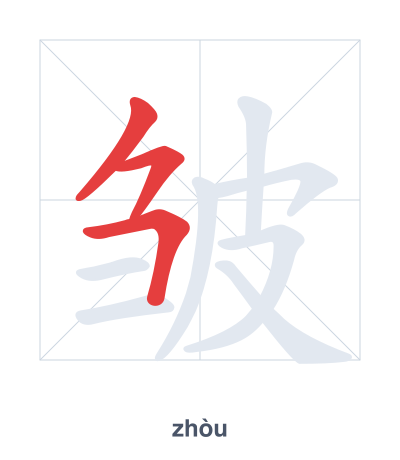
Open Hanzi Writer to see the animated stroke order and practice writing 皱 with real-time feedback.
The character 皱 (zhòu) is written with 10 strokes. Follow the standard Chinese stroke order: top to bottom, left to right, outside before inside. The radical 皮 is one of its key components.
Practice the correct stroke order with the Hanzi Writer app to see animated stroke-by-stroke guidance with real-time feedback.
皱 means wrinkle.
As an HSK Level 7 character, 皱 is an intermediate-level character.
The character 皱 combines the radical 皮 (skin) with 刍, which originally depicted grass or a mowing tool and here serves as a phonetic component hinting at the pronunciation zhòu. The overall structure signifies wrinkled skin, as the skin radical directly points to the surface where wrinkles form.
💡 Memory Tip: Imagine a piece of skin (皮) crumpled like a piece of paper, with the left side (刍) looking like tiny creases or folds.
他脸上有了皱纹。
tā liǎn shàng yǒu le zhòu wén
He has wrinkles on his face.
你为什么皱眉?
nǐ wèi shén me zhòu méi
Why are you frowning?
这件衣服皱了。
zhè jiàn yī fú zhòu le
This piece of clothing is wrinkled.
Open Hanzi Writer to see the animated stroke order and practice writing 皱 with real-time feedback.
✨ Animated stroke order · Handwriting recognition · HSK-graded practice · Free to use
The left side is 皮 (pí), meaning 'skin' or 'leather'. The right side is 刍 (chú), which originally meant 'fodder' but here hints at the pronunciation. Together, they suggest the idea of skin folding or wrinkling.