皻 (zhā) means "rosacea" in Chinese. It has 16 strokes with the radical 皮.
Rated 3.8/5 in difficulty (challenging).
Appears in 3+ common words including 酒皻鼻 (jiǔ zhā bí), 酒皻 (jiǔ zhā), 皻面 (zhā miàn).
Due to its 16 strokes, Hanzi Writer's error detection shows 皻 requires focused practice — most learners need 10+ attempts for consistent accuracy.
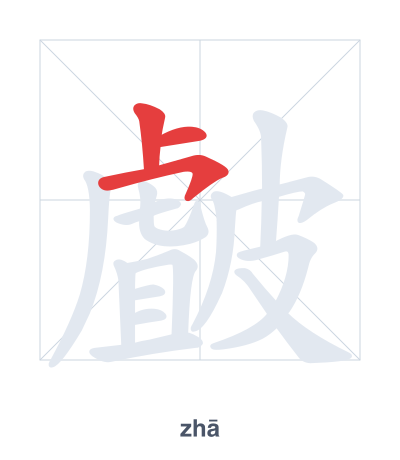
Open Hanzi Writer to see the animated stroke order and practice writing 皻 with real-time feedback.
The character 皻 (zhā) is written with 16 strokes. Follow the standard Chinese stroke order: top to bottom, left to right, outside before inside. The radical 皮 is one of its key components.
Practice the correct stroke order with the Hanzi Writer app to see animated stroke-by-stroke guidance with real-time feedback.
皻 means rosacea.
| Character | 皻 |
| Pinyin | zhā (zha) |
| Meaning | rosacea |
| Strokes | 16 |
| Radical | 皮 |
| Difficulty | 3.8/5 |
皻 combines the radical 皮 (skin) with the component 虘 (coarse, rough), indicating a skin condition characterized by roughness and redness—rosacea.
💡 Memory Tip: Picture a face with red, bumpy skin like a rough tiger's tongue (虘) scraping against the skin (皮).
他有一个酒皻鼻。
tā yǒu yí gè jiǔ zhā bí
He has a rosacea nose.
酒皻是一种皮肤病。
jiǔ zhā shì yī zhǒng pí fū bìng
Rosacea is a type of skin disease.
他的脸部有皻面。
tā de liǎn bù yǒu zhā miàn
He has rosacea on his face.
Open Hanzi Writer to see the animated stroke order and practice writing 皻 with real-time feedback.
✨ Animated stroke order · Handwriting recognition · HSK-graded practice · Free to use
The character 皻 is composed of the radical 皮 (skin) on the left and the component 虘 (cuó, meaning coarse or rough) on the right. This structure directly points to a rough skin condition, as 皮 indicates skin and 虘 suggests the texture of the affected area.