疐 (zhì) means "To stumble; to be hindered" in Chinese. It has 14 strokes with the radical 田.
Rated 4.2/5 in difficulty (advanced).
Appears in 3+ common words including 疐碍 (zhì ài), 疐踬 (zhì zhì), 进退维疐 (jìn tuì wéi zhì).
Due to its 14 strokes, Hanzi Writer's error detection shows 疐 requires focused practice — most learners need 10+ attempts for consistent accuracy.
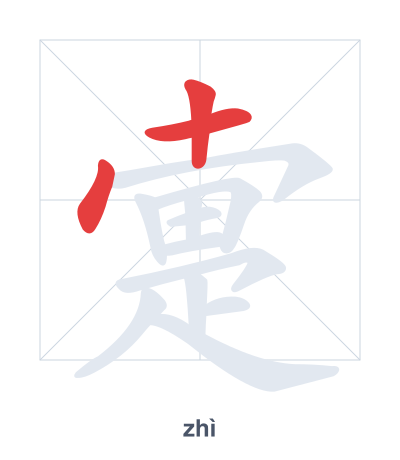
Open Hanzi Writer to see the animated stroke order and practice writing 疐 with real-time feedback.
The character 疐 (zhì) is written with 14 strokes. Follow the standard Chinese stroke order: top to bottom, left to right, outside before inside. The radical 田 is one of its key components.
Practice the correct stroke order with the Hanzi Writer app to see animated stroke-by-stroke guidance with real-time feedback.
疐 means To stumble; to be hindered.
疐 combines 田 (field) with 夂 (a foot moving slowly or backward), depicting a foot that stumbles over uneven ground or obstacles in a field, hence 'to stumble' or 'be hindered'.
💡 Memory Tip: Imagine a foot (夂) catching on a ridge in a field (田), causing you to stumble forward.
事情有了疐碍。
shì qíng yǒu le zhì ài
The matter has encountered an obstacle.
他走路有些疐踬。
tā zǒu lù yǒu xiē zhì zhì
He walks with some difficulty.
他现在进退维疐。
tā xiàn zài jìn tuì wéi zhì
He is now in a dilemma.
Open Hanzi Writer to see the animated stroke order and practice writing 疐 with real-time feedback.
✨ Animated stroke order · Handwriting recognition · HSK-graded practice · Free to use
The character 疐 is composed of 田 (field) on top and 夊 (slow walking with dragging feet) on the bottom. The field represents the ground, and the dragging feet suggest tripping or stumbling while walking. Together, they create the meaning of being hindered or stumbling.