诤 (zhèng) means "to admonish; to argue" in Chinese. It has 8 strokes with the radical 讠.
Rated 3.4/5 in difficulty (challenging).
Appears in 3+ common words including 诤友 (zhèng yǒu), 诤言 (zhèng yán), 谏诤 (jiàn zhèng).
Due to its 8 strokes, Hanzi Writer's error detection shows 诤 requires focused practice — most learners need 10+ attempts for consistent accuracy.
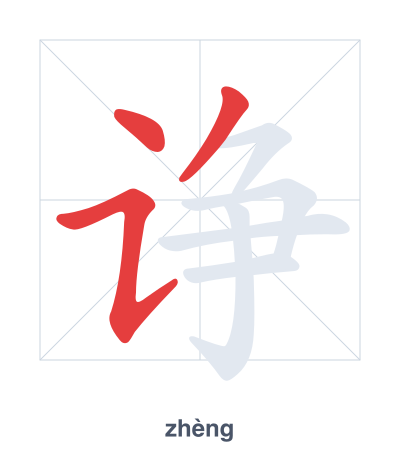
Open Hanzi Writer to see the animated stroke order and practice writing 诤 with real-time feedback.
The character 诤 (zhèng) is written with 8 strokes. Follow the standard Chinese stroke order: top to bottom, left to right, outside before inside. The radical 讠 is one of its key components.
Practice the correct stroke order with the Hanzi Writer app to see animated stroke-by-stroke guidance with real-time feedback.
诤 means to admonish; to argue.
诤 is a compound character formed from 讠 (speech) and 争 (zhēng, 'to contend'). The speech radical indicates that the meaning involves words, while 争 contributes the idea of striving or fighting, together conveying 'to admonish' or 'argue'—using words to contend with someone to correct them.
💡 Memory Tip: Picture a person speaking (讠) while pulling on a rope in a tug-of-war (争) because arguing (诤) is a verbal struggle.
他是我的一个诤友。
tā shì wǒ de yí gè zhèng yǒu
He is a friend of mine who gives frank advice.
谢谢你对我的诤言。
xiè xiè nǐ duì wǒ de zhèng yán
Thank you for your honest advice.
他敢于向领导谏诤。
tā gǎn yú xiàng lǐng dǎo jiàn zhèng
He dared to remonstrate with the leadership.
Open Hanzi Writer to see the animated stroke order and practice writing 诤 with real-time feedback.
✨ Animated stroke order · Handwriting recognition · HSK-graded practice · Free to use
诤 is composed of the radical 讠 (speech) on the left and 争 (zhēng, to contend) on the right. The speech radical indicates that the character involves words or speaking, while 争 suggests the idea of arguing or struggling with words. Together they form the meaning of admonishing or arguing directly.