笮 (zé) means "Bamboo rope" in Chinese. It has 11 strokes with the radical 竹.
Rated 4.2/5 in difficulty (advanced).
Appears in 3+ common words including 笮桥 (zé qiáo), 笮人 (zé rén), 笮马 (zé mǎ).
Due to its 11 strokes, Hanzi Writer's error detection shows 笮 requires focused practice — most learners need 10+ attempts for consistent accuracy.
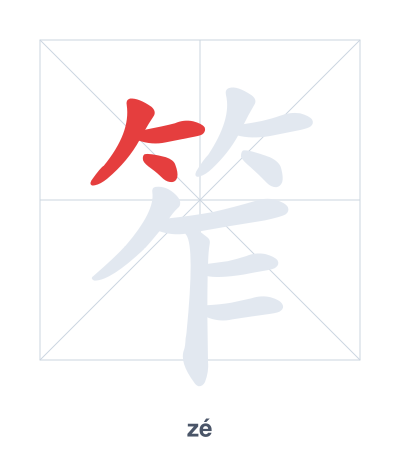
Open Hanzi Writer to see the animated stroke order and practice writing 笮 with real-time feedback.
The character 笮 (zé) is written with 11 strokes. Follow the standard Chinese stroke order: top to bottom, left to right, outside before inside. The radical 竹 is one of its key components.
Practice the correct stroke order with the Hanzi Writer app to see animated stroke-by-stroke guidance with real-time feedback.
笮 means Bamboo rope.
笮 is a compound character where the radical 竹 (bamboo) indicates the material, and the component 乍 (zhà, meaning 'to make' or 'to press') suggests the action of twisting bamboo strips into a rope. Together, they depict a bamboo rope made by pressing and twisting fibers.
💡 Memory Tip: Picture a bamboo stalk (竹) being twisted and compressed (乍 looks like a twisted knot) into a strong rope.
河上有一座古老的笮桥。
hé shàng yǒu yī zuò gǔ lǎo de zé qiáo
There is an ancient bamboo cable bridge over the river.
他是古代的笮人。
tā shì gǔ dài de zé rén
He was a Ze person of ancient times.
这种马被称为笮马。
zhè zhǒng mǎ bèi chēng wéi zé mǎ
This kind of horse is called a Ze horse.
Open Hanzi Writer to see the animated stroke order and practice writing 笮 with real-time feedback.
✨ Animated stroke order · Handwriting recognition · HSK-graded practice · Free to use
笮 is a top-bottom character. The top part is 竹 (bamboo), and the bottom part is 乍 (zhà, which here suggests the sound and also the idea of pressing or binding). Together, they show bamboo strips used as rope, often for tying or making bridges.