唣 (zào) means "Noise / To chatter" in Chinese. It has 10 strokes with the radical 口.
Rated 4.2/5 in difficulty (advanced).
Appears in 3+ common words including 啰唣 (luō zào), 烦唣 (fán zào), 听着啰唣 (tīng zhe luō zào).
Due to its 10 strokes, Hanzi Writer's error detection shows 唣 requires focused practice — most learners need 10+ attempts for consistent accuracy.
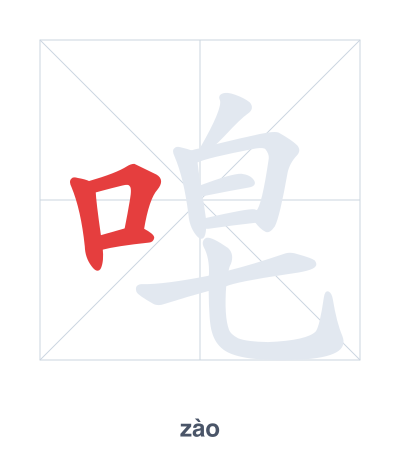
Open Hanzi Writer to see the animated stroke order and practice writing 唣 with real-time feedback.
The character 唣 (zào) is written with 10 strokes. Follow the standard Chinese stroke order: top to bottom, left to right, outside before inside. The radical 口 is one of its key components.
Practice the correct stroke order with the Hanzi Writer app to see animated stroke-by-stroke guidance with real-time feedback.
唣 means Noise / To chatter.
唣 is a compound character with the mouth radical (口) indicating sound or speech, and the phonetic component 皂 (zào) providing the pronunciation. Together they suggest the mouth producing noise or chatter.
💡 Memory Tip: Picture a mouth (口) blowing soap bubbles (皂) that pop with a loud, chattering noise.
别在这里啰唣。
bié zài zhè lǐ luō zào
Don't make a racket here.
这件事很烦唣。
zhè jiàn shì hěn fán zào
This matter is very annoying.
这话听着啰唣。
zhè huà tīng zhe luō zào
These words sound annoying.
Open Hanzi Writer to see the animated stroke order and practice writing 唣 with real-time feedback.
✨ Animated stroke order · Handwriting recognition · HSK-graded practice · Free to use
唣 combines the radical 口 (mouth) on the left with 喿 (zào) on the right. 喿 itself contains three 口 (mouths) stacked above 木 (tree), suggesting many mouths making noise. This structure directly relates to the meaning of noise or chattering.