崽 (zǎi) means "Cub / pup / young animal" in Chinese. It has 12 strokes with the radical 山.
Rated 4.2/5 in difficulty (advanced).
Appears in 3+ common words including 猪崽 (zhū zǎi), 狗崽 (gǒu zǎi), 崽子 (zǎi zi).
Due to its 12 strokes, Hanzi Writer's error detection shows 崽 requires focused practice — most learners need 10+ attempts for consistent accuracy.
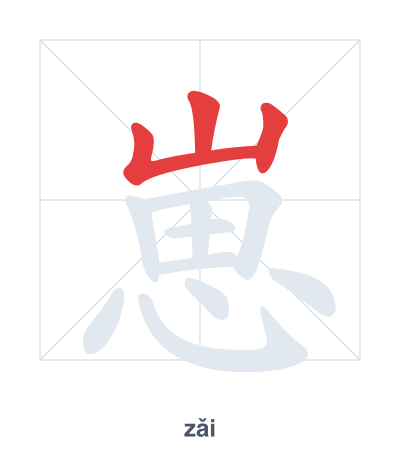
Open Hanzi Writer to see the animated stroke order and practice writing 崽 with real-time feedback.
The character 崽 (zǎi) is written with 12 strokes. Follow the standard Chinese stroke order: top to bottom, left to right, outside before inside. The radical 山 is one of its key components.
Practice the correct stroke order with the Hanzi Writer app to see animated stroke-by-stroke guidance with real-time feedback.
崽 means Cub / pup / young animal.
The character 崽 combines the radical 山 (mountain) as a semantic clue for a wild habitat, and 思 (to think), which may hint at the young animal's alertness or serve as a phonetic element. Together, they evoke a cub or pup in the mountains, always watchful.
💡 Memory Tip: Picture a tiny cub perched on a mountain (山) peak, thinking (思) hard about how to get its mother's attention.
农场里有很多猪崽。
nóng chǎng lǐ yǒu hěn duō zhū zǎi
There are many piglets on the farm.
这只狗崽很可爱。
zhè zhǐ gǒu zǎi hěn kě ài
This puppy is very cute.
别叫他小崽子。
bié jiào tā xiǎo zǎi zi
Don't call him a brat.
Open Hanzi Writer to see the animated stroke order and practice writing 崽 with real-time feedback.
✨ Animated stroke order · Handwriting recognition · HSK-graded practice · Free to use
The character 崽 consists of 山 (mountain) on top and 思 (think) on the bottom. The meaning 'cub' likely comes from the idea of a young animal living in the mountains, but the connection to 思 is not direct. Instead, focus on remembering that the top radical 山 appears in many animal-related characters.