隅 (yú) means "Corner / Nook" in Chinese. It has 11 strokes with the radical 阝.
Rated 3.9/5 in difficulty (challenging).
Appears in 3+ common words including 墙隅 (qiáng yú), 隅角 (yú jiǎo), 偏隅 (piān yú).
Due to its 11 strokes, Hanzi Writer's error detection shows 隅 requires focused practice — most learners need 10+ attempts for consistent accuracy.
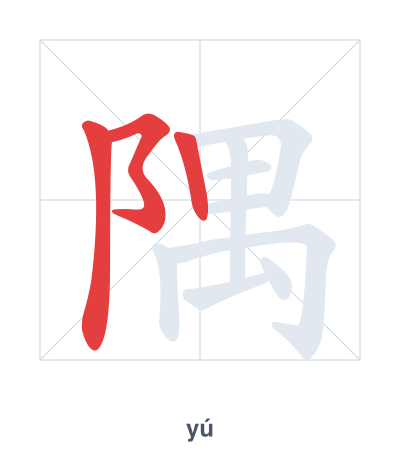
Open Hanzi Writer to see the animated stroke order and practice writing 隅 with real-time feedback.
The character 隅 (yú) is written with 11 strokes. Follow the standard Chinese stroke order: top to bottom, left to right, outside before inside. The radical 阝 is one of its key components.
Practice the correct stroke order with the Hanzi Writer app to see animated stroke-by-stroke guidance with real-time feedback.
隅 means Corner / Nook.
The character 隅 combines the radical 阝 (a hill or mound) with the phonetic component 禺 (yú, also a mythical creature). This suggests a nook or corner formed by a hillside—a recessed or secluded spot. The visual form thus literally depicts a "hill corner."
💡 Memory Tip: Picture a hill (阝) with a playful monkey (禺) hiding in its nook, peeking around the corner.
书放在墙隅的桌上。
shū fàng zài qiáng yú de zhuō shàng
The book is on the table in the corner of the wall.
这是一个隅角。
zhè shì yí gè yú jiǎo
This is a corner.
他住在这个偏隅之地。
tā zhù zài zhè ge piān yú zhī dì
He lives in this remote corner.
Open Hanzi Writer to see the animated stroke order and practice writing 隅 with real-time feedback.
✨ Animated stroke order · Handwriting recognition · HSK-graded practice · Free to use
The character 隅 has two parts: the left radical 阝, which is a form of 阜 meaning 'mound' or 'hill', and the right side 禺 (yú, an ancient mythical animal). The left radical suggests the meaning is related to terrain or a place, while the right side gives the sound. Together, they form the idea of a corner or nook, like a sheltered spot beside a hill.