喁 (yóng) means "sound of breathing; fish gasping" in Chinese. It has 12 strokes with the radical 口.
Rated 4.2/5 in difficulty (advanced).
Appears in 3+ common words including 喁喁 (yóng yóng), 喁喁私语 (yóng yóng sī yǔ), 喁喁细语 (yóng yóng xì yǔ).
Due to its 12 strokes, Hanzi Writer's error detection shows 喁 requires focused practice — most learners need 10+ attempts for consistent accuracy.
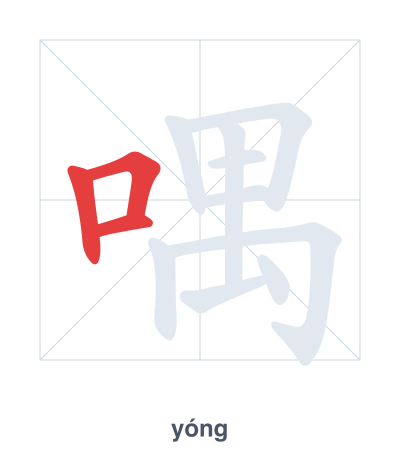
Open Hanzi Writer to see the animated stroke order and practice writing 喁 with real-time feedback.
The character 喁 (yóng) is written with 12 strokes. Follow the standard Chinese stroke order: top to bottom, left to right, outside before inside. The radical 口 is one of its key components.
Practice the correct stroke order with the Hanzi Writer app to see animated stroke-by-stroke guidance with real-time feedback.
喁 means sound of breathing; fish gasping.
The character 喁 combines the mouth radical 口 with 禺, which originally depicted a region but here provides phonetic cues. In classical Chinese, it describes the sound of a fish gasping or opening its mouth, visually showing the mouth (口) engaged in breathing or gaping motion.
💡 Memory Tip: Picture a fish (禺) with its mouth (口) wide open, gasping desperately for air.
他们在喁喁。
tā men zài yóng yóng
They are whispering softly.
两人在私语。
liǎng rén zài sī yǔ
The two are whispering.
听到细语。
tīng dào xì yǔ
Heard a whisper.
Open Hanzi Writer to see the animated stroke order and practice writing 喁 with real-time feedback.
✨ Animated stroke order · Handwriting recognition · HSK-graded practice · Free to use
The character 喁 is made of two parts: the radical 口 (mouth) on the left and the component 禺 on the right. The mouth radical shows that the character relates to sound or breathing, and 禺 gives the pronunciation yóng. Together, they create the idea of the sound of breathing or a fish gasping for air through its mouth.