撄 (yīng) means "to disturb" in Chinese. It has 14 strokes with the radical 扌.
Rated 4.2/5 in difficulty (advanced).
Appears in 3+ common words including 撄锋 (yīng fēng), 撄扰 (yīng rǎo), 撄心 (yīng xīn).
Due to its 14 strokes, Hanzi Writer's error detection shows 撄 requires focused practice — most learners need 10+ attempts for consistent accuracy.
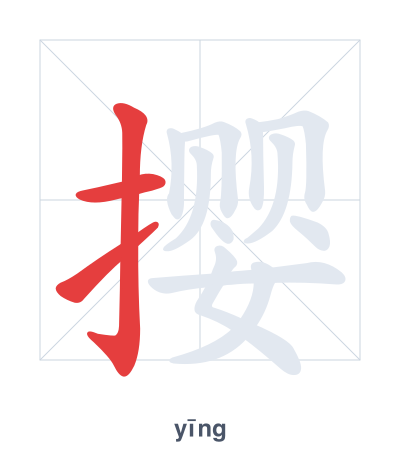
Open Hanzi Writer to see the animated stroke order and practice writing 撄 with real-time feedback.
The character 撄 (yīng) is written with 14 strokes. Follow the standard Chinese stroke order: top to bottom, left to right, outside before inside. The radical 扌 is one of its key components.
Practice the correct stroke order with the Hanzi Writer app to see animated stroke-by-stroke guidance with real-time feedback.
撄 means to disturb.
撄 combines the hand radical 扌 (action of hand) with 婴 (baby), suggesting the act of touching or disturbing a baby, which agitates it. It originally meant 'to touch' or 'to disturb' and extended to mean 'to provoke' or 'to harass'.
💡 Memory Tip: Imagine a hand (扌) poking a crying baby (婴) to disturb its peace.
莫要撄其锋芒。
mò yào yīng qí fēng máng
Do not confront the brunt of the attack.
别让俗事撄扰。
bié ràng sú shì yīng rǎo
Don't let worldly affairs disturb you.
此事撄人心弦。
cǐ shì yīng rén xīn xián
This matter tugs at one's heartstrings.
Open Hanzi Writer to see the animated stroke order and practice writing 撄 with real-time feedback.
✨ Animated stroke order · Handwriting recognition · HSK-graded practice · Free to use
撄 is composed of the radical 扌 (hand) on the left and 婴 on the right. The hand radical suggests an action, while 婴 (a baby) adds a sound component. Together, they convey the idea of physically disturbing or harassing something, like grabbing at a baby.