檃 (yǐn) means "wood-straightening tool" in Chinese. It has 16 strokes with the radical 木.
Rated 4.2/5 in difficulty (advanced).
Appears in 3+ common words including 檃括 (yǐn kuò), 檃栝 (yǐn guā), 檃正 (yǐn zhèng).
Due to its 16 strokes, Hanzi Writer's error detection shows 檃 requires focused practice — most learners need 10+ attempts for consistent accuracy.
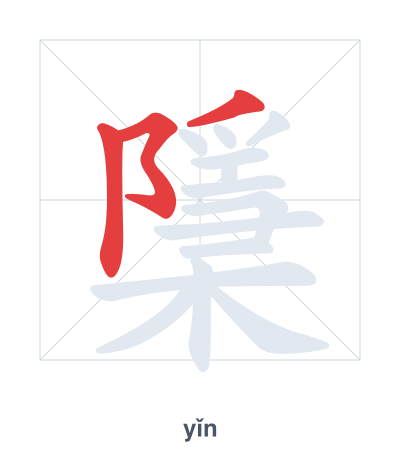
Open Hanzi Writer to see the animated stroke order and practice writing 檃 with real-time feedback.
The character 檃 (yǐn) is written with 16 strokes. Follow the standard Chinese stroke order: top to bottom, left to right, outside before inside. The radical 木 is one of its key components.
Practice the correct stroke order with the Hanzi Writer app to see animated stroke-by-stroke guidance with real-time feedback.
檃 means wood-straightening tool.
檃 combines the radical 木 (wood) with 隱 (yǐn, 'hidden'), suggesting a tool that hides imperfections in wood by straightening it. The character describes a carpenter's device used to press and align crooked timber, emphasizing the concealed correction of wood's shape.
💡 Memory Tip: Imagine a woodworker hiding a bent branch inside a large wooden clamp (木) that secretly (隱) straightens it without anyone seeing.
他在檃括木材。
tā zài yǐn kuò mù cái
He is shaping the wood.
这是一个檃栝。
zhè shì yí gè yǐn guā
This is a shaping tool.
檃正木材的形状。
yǐn zhèng mù cái de xíng zhuàng
Straighten the shape of the wood.
Open Hanzi Writer to see the animated stroke order and practice writing 檃 with real-time feedback.
✨ Animated stroke order · Handwriting recognition · HSK-graded practice · Free to use
The character 檃 combines the radical 木 (wood) on the left with the component 㥯 on the right. 㥯 carries the idea of bending or concealing, and together with wood it describes a tool used to straighten crooked timber. This directly matches the meaning "wood-straightening tool."