垔 (yīn) means "to block; to dam" in Chinese. It has 9 strokes with the radical 土.
Rated 4/5 in difficulty (challenging).
Appears in 3+ common words including 垔塞 (yīn sāi), 垔堵 (yīn dǔ), 垔灭 (yīn miè).
Due to its 9 strokes, Hanzi Writer's error detection shows 垔 requires focused practice — most learners need 10+ attempts for consistent accuracy.
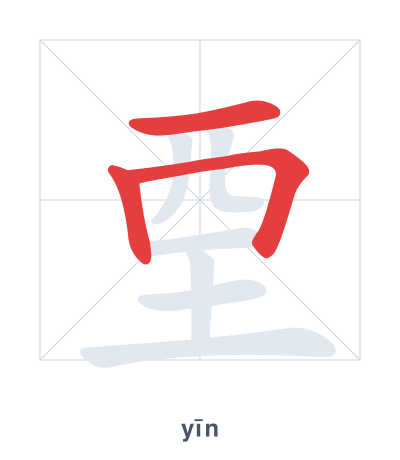
Open Hanzi Writer to see the animated stroke order and practice writing 垔 with real-time feedback.
The character 垔 (yīn) is written with 9 strokes. Follow the standard Chinese stroke order: top to bottom, left to right, outside before inside. The radical 土 is one of its key components.
Practice the correct stroke order with the Hanzi Writer app to see animated stroke-by-stroke guidance with real-time feedback.
垔 means to block; to dam.
垔 combines the radical 土 (earth) with a top component resembling a barrier or enclosure. The overall structure depicts piling up earth to form a dam or blockage, directly connecting to the meaning 'to block; to dam'.
💡 Memory Tip: Picture a huge mound of earth (土) under a cross-shaped barricade, blocking a river's flow.
道路被泥土垔塞了。
dào lù bèi ní tǔ yīn sāi le
The road was blocked by mud.
水流被石头垔堵了。
shuǐ liú bèi shí tou yīn dǔ le
The water flow was blocked by stones.
这种文化没有垔灭。
zhè zhǒng wén huà méi yǒu yīn miè
This culture has not been extinguished.
Open Hanzi Writer to see the animated stroke order and practice writing 垔 with real-time feedback.
✨ Animated stroke order · Handwriting recognition · HSK-graded practice · Free to use
The character 垔 is made of two parts: 西 (xī, meaning "west") on top and 土 (tǔ, meaning "earth") on the bottom. The earth radical directly connects to the character's meaning of blocking or damming, as dams are often built from earth. The "west" component may originally have suggested a direction, but today the structure simply shows an earth-based action.