诣 (yì) means "attainment; to visit (formal)" in Chinese. It has 8 strokes with the radical 讠.
Rated 3.4/5 in difficulty (challenging).
Appears in 3+ common words including 造诣 (zào yì), 苦心孤诣 (kǔ xīn gū yì), 诣见 (yì jiàn).
Due to its 8 strokes, Hanzi Writer's error detection shows 诣 requires focused practice — most learners need 10+ attempts for consistent accuracy.
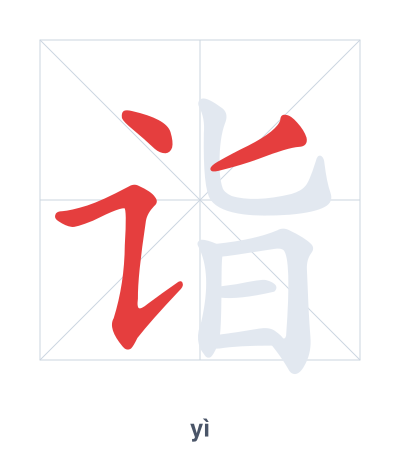
Open Hanzi Writer to see the animated stroke order and practice writing 诣 with real-time feedback.
The character 诣 (yì) is written with 8 strokes. Follow the standard Chinese stroke order: top to bottom, left to right, outside before inside. The radical 讠 is one of its key components.
Practice the correct stroke order with the Hanzi Writer app to see animated stroke-by-stroke guidance with real-time feedback.
诣 means attainment; to visit (formal).
诣 combines the speech radical 讠 (words) with 旨 (purpose/meaning). The character suggests that one's words reach a specific purpose, hence attainment; the formal visit meaning arises from the idea of arriving at someone's place with intention.
💡 Memory Tip: Imagine a scholar (讠) arriving at a VIP's gate with a scroll of purpose (旨) — that's a formal visit to attain wisdom.
他在绘画上有很高造诣。
tā zài huì huà shàng yǒu hěn gāo zào yì
He has great attainments in painting.
他苦心孤诣地钻研学术。
tā kǔ xīn gū yì dì zuān yán xué shù
He devoted himself wholeheartedly to his academic studies.
他亲自诣见那位老师。
tā qīn zì yì jiàn nà wèi lǎo shī
He went to visit that teacher in person.
Open Hanzi Writer to see the animated stroke order and practice writing 诣 with real-time feedback.
✨ Animated stroke order · Handwriting recognition · HSK-graded practice · Free to use
The left component 讠 (speech radical) indicates the character relates to speaking or language. The right component 旨 (zhǐ) means 'aim' or 'purpose'. Together, 诣 conveys the idea of reaching a goal through speech or formal visit, which aligns with its meanings of 'attainment' and 'to visit a superior'.