蜴 (yì) means "Lizard" in Chinese. It has 14 strokes with the radical 虫.
Rated 4.2/5 in difficulty (advanced).
Appears in 3+ common words including 蜥蜴 (xī yì), 变色蜴 (biàn sè yì), 巨蜴 (jù yì).
Due to its 14 strokes, Hanzi Writer's error detection shows 蜴 requires focused practice — most learners need 10+ attempts for consistent accuracy.
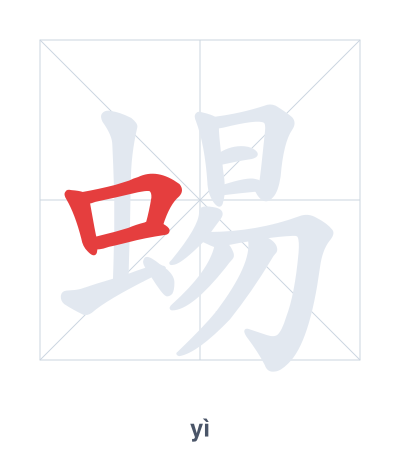
Open Hanzi Writer to see the animated stroke order and practice writing 蜴 with real-time feedback.
The character 蜴 (yì) is written with 14 strokes. Follow the standard Chinese stroke order: top to bottom, left to right, outside before inside. The radical 虫 is one of its key components.
Practice the correct stroke order with the Hanzi Writer app to see animated stroke-by-stroke guidance with real-time feedback.
蜴 means Lizard.
蜴 is a compound character combining the radical 虫 (insect/reptile) with the phonetic component 易 (yì, meaning 'change' or 'easy'). The 虫 radical indicates this character refers to a reptile, specifically a lizard. The 易 component provides the pronunciation yì and hints at the lizard's ability to change color easily.
💡 Memory Tip: Picture a lizard (虫) with a neon sign reading 'EASY' (易), because it easily blends into any background.
蜥蜴喜欢吃昆虫。
xī yì xǐ huān chī kūn chóng
Lizards like to eat insects.
变色蜴会变色。
biàn sè yì huì biàn sè
Chameleons can change color.
巨蜴住在岛上。
jù yì zhù zài dǎo shàng
Giant lizards live on the island.
Open Hanzi Writer to see the animated stroke order and practice writing 蜴 with real-time feedback.
✨ Animated stroke order · Handwriting recognition · HSK-graded practice · Free to use
The character 蜴 consists of the radical 虫 (insect/reptile) on the left and the phonetic component 易 (yì) on the right. The radical indicates that the character is related to reptiles or insects, specifically lizards. The right part 易 hints at the pronunciation "yì."