倻 (yē) means "(used in names, e.g., Gaya confederacy)" in Chinese. It has 10 strokes with the radical 亻.
Rated 3.9/5 in difficulty (challenging).
Appears in 3+ common words including 伽倻琴 (gā yē qín), 伽倻 (gā yē), 弹倻琴 (dàn yē qín).
Due to its 10 strokes, Hanzi Writer's error detection shows 倻 requires focused practice — most learners need 10+ attempts for consistent accuracy.
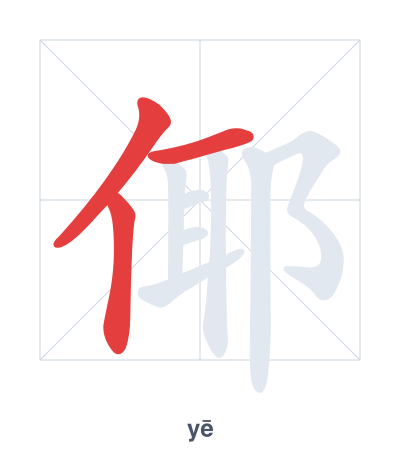
Open Hanzi Writer to see the animated stroke order and practice writing 倻 with real-time feedback.
The character 倻 (yē) is written with 10 strokes. Follow the standard Chinese stroke order: top to bottom, left to right, outside before inside. The radical 亻 is one of its key components.
Practice the correct stroke order with the Hanzi Writer app to see animated stroke-by-stroke guidance with real-time feedback.
倻 means (used in names, e.g., Gaya confederacy).
倻 is a compound character combining the radical 亻 (person) with 耶 (yē, a phonetic component originally meaning 'ear' plus 'city'). It was created as a phonetic loan to transcribe foreign names, such as the ancient Gaya confederacy in Korea, where the sound 'ya' was approximated.
💡 Memory Tip: Picture a person (亻) with a giant ear (耳) standing next to a city (阝) to represent the foreign name 'Gaya' being heard and recorded.
伽倻琴的声音很好听。
gā yē qín de shēng yīn hěn hǎo tīng
The sound of the gayageum is very beautiful.
他研究伽倻的历史。
tā yán jiū gā yē de lì shǐ
He studies the history of Gaya.
她在学习弹倻琴。
tā zài xué xí dàn yē qín
She is learning to play the gayageum.
Open Hanzi Writer to see the animated stroke order and practice writing 倻 with real-time feedback.
✨ Animated stroke order · Handwriting recognition · HSK-graded practice · Free to use
The character 倻 consists of the person radical 亻 on the left and the phonetic component 耶 on the right. The 亻 indicates that the character relates to people, while 耶 gives the pronunciation yē. The meaning is not directly derived from the parts — instead, 倻 is used mainly in proper names like Gaya (伽倻) and the instrument gayageum (伽倻琴).