样 (yàng) means "Sample; Pattern; Appearance" in Chinese. It has 10 strokes with the radical 木, and is HSK Level 1.
Rated 3.7/5 in difficulty (challenging).
Harder than 90% of HSK Level 1 characters.
Appears in 3+ common words including 样子 (yàng zi), 一样 (yī yàng), 榜样 (bǎng yàng).
Due to its 10 strokes, Hanzi Writer's error detection shows 样 requires focused practice — most learners need 10+ attempts for consistent accuracy.
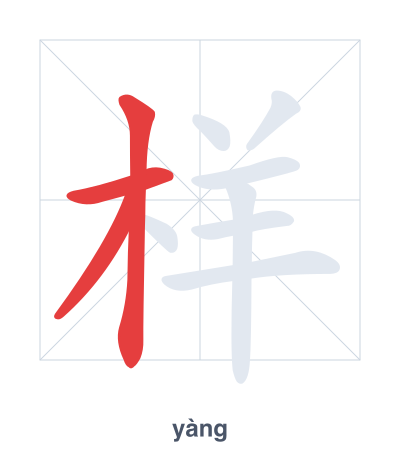
Open Hanzi Writer to see the animated stroke order and practice writing 样 with real-time feedback.
The character 样 (yàng) is written with 10 strokes. Follow the standard Chinese stroke order: top to bottom, left to right, outside before inside. The radical 木 is one of its key components.
Practice the correct stroke order with the Hanzi Writer app to see animated stroke-by-stroke guidance with real-time feedback.
样 means Sample; Pattern; Appearance.
As an HSK Level 1 character, 样 is among the first characters beginners learn.
样 is the simplified form of 樣, combining the radical 木 (wood) on the left and 羊 (sheep) on the right. In ancient contexts, wooden models or patterns were carved for reference, and 羊 contributes both the sound (yáng) and originally hinted at something shaped or patterned. Thus, the character visually links a wooden object (木) with a sheep (羊) to represent a sample or pattern used as a template.
💡 Memory Tip: Picture a wooden sheep (木+羊) standing as a sample pattern for other carvers to copy.
他的样子很可爱。
tā de yàng zi hěn kě ài
He looks very cute.
我和他穿得一样。
wǒ hé tā chuān dé yī yàng
I'm dressed the same as him.
他是我们的好榜样。
tā shì wǒ men de hǎo bǎng yàng
He is a good role model for us.
Open Hanzi Writer to see the animated stroke order and practice writing 样 with real-time feedback.
✨ Animated stroke order · Handwriting recognition · HSK-graded practice · Free to use
样 is composed of the radical 木 (wood) on the left and the phonetic component 羊 (sheep) on the right. The wood radical suggests that 样 originally referred to a wooden pattern or model, while 羊 provides the pronunciation yàng. Together, they form a character meaning 'sample' or 'appearance.'