秧 (yāng) means "seedling" in Chinese. It has 10 strokes with the radical 禾, and is HSK Level 7.
Rated 4.2/5 in difficulty (advanced).
Harder than 76% of HSK Level 7 characters.
Appears in 3+ common words including 秧苗 (yāng miáo), 插秧 (chā yāng), 扭秧歌 (niǔ yāng gē).
Due to its 10 strokes, Hanzi Writer's error detection shows 秧 requires focused practice — most learners need 10+ attempts for consistent accuracy.
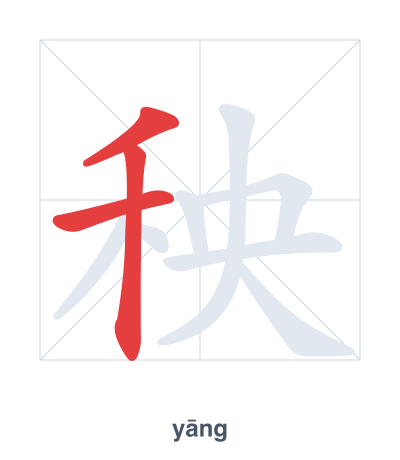
Open Hanzi Writer to see the animated stroke order and practice writing 秧 with real-time feedback.
The character 秧 (yāng) is written with 10 strokes. Follow the standard Chinese stroke order: top to bottom, left to right, outside before inside. The radical 禾 is one of its key components.
Practice the correct stroke order with the Hanzi Writer app to see animated stroke-by-stroke guidance with real-time feedback.
秧 means seedling.
As an HSK Level 7 character, 秧 is an intermediate-level character.
This character combines the radical 禾 (grain) with 央 (center, also phonetic yāng), indicating a young rice plant that stands at the center of the paddy field, ready for transplanting.
💡 Memory Tip: Picture a tiny grain plant (禾) rising from the exact middle (央) of a muddy field—the seedling needs to be moved to its final spot.
秧苗长得很绿。
yāng miáo zhǎng dé hěn lǜ
The seedlings are growing very green.
农民在田里插秧。
nóng mín zài tián lǐ chā yāng
Farmers are transplanting rice seedlings.
老人们在扭秧歌。
lǎo rén men zài niǔ yāng gē
The elderly people are performing the Yangko dance.
Open Hanzi Writer to see the animated stroke order and practice writing 秧 with real-time feedback.
✨ Animated stroke order · Handwriting recognition · HSK-graded practice · Free to use
秧 is made of the radical 禾 (grain) on the left and 央 (center) on the right. The 禾 part relates to plants, and 央 gives the sound, so together they mean a young plant, specifically a rice seedling.