赙 (fù) means "to give money for funeral expenses" in Chinese. It has 14 strokes with the radical 贝.
Rated 4.2/5 in difficulty (advanced).
Appears in 3+ common words including 赙仪 (fù yí), 赙金 (fù jīn), 赙赠 (fù zèng).
Due to its 14 strokes, Hanzi Writer's error detection shows 赙 requires focused practice — most learners need 10+ attempts for consistent accuracy.
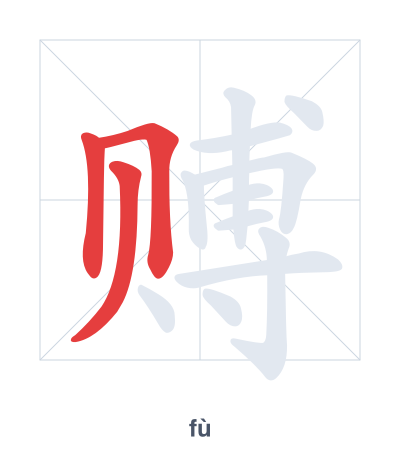
Open Hanzi Writer to see the animated stroke order and practice writing 赙 with real-time feedback.
The character 赙 (fù) is written with 14 strokes. Follow the standard Chinese stroke order: top to bottom, left to right, outside before inside. The radical 贝 is one of its key components.
Practice the correct stroke order with the Hanzi Writer app to see animated stroke-by-stroke guidance with real-time feedback.
赙 means to give money for funeral expenses.
The character 赙 combines the radical 贝 (shell, representing money) with 尃 (fū, 'to spread or bestow'), indicating the act of giving funds. In ancient China, shells served as currency, and this character specifically denotes contributing money for funeral expenses.
💡 Memory Tip: Picture a mourner spreading (尃) seashells (贝) onto a grave as a monetary gift for the funeral costs.
他送去一份赙仪。
tā sòng qù yī fèn fù yí
He sent a gift of money for a funeral.
赙金已经收到了。
fù jīn yǐ jīng shōu dào le
The funeral contribution has been received.
亲友们前来赙赠。
qīn yǒu men qián lái fù zèng
Relatives and friends came to offer funeral donations.
Open Hanzi Writer to see the animated stroke order and practice writing 赙 with real-time feedback.
✨ Animated stroke order · Handwriting recognition · HSK-graded practice · Free to use
赙 is made of two parts: the left side 贝 (shell) represents money or wealth, and the right side 尃 gives a phonetic hint. Since 贝 relates to money, the character's meaning of giving funeral money comes from this structure.