恹 (yān) means "Weak or listless." in Chinese. It has 9 strokes with the radical 忄.
Rated 4/5 in difficulty (challenging).
Appears in 3+ common words including 恹恹 (yān yān), 病恹恹 (bìng yān yān), 恹恹欲睡 (yān yān yù shuì).
Due to its 9 strokes, Hanzi Writer's error detection shows 恹 requires focused practice — most learners need 10+ attempts for consistent accuracy.
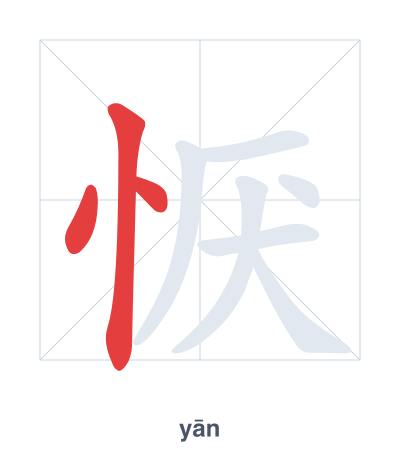
Open Hanzi Writer to see the animated stroke order and practice writing 恹 with real-time feedback.
The character 恹 (yān) is written with 9 strokes. Follow the standard Chinese stroke order: top to bottom, left to right, outside before inside. The radical 忄 is one of its key components.
Practice the correct stroke order with the Hanzi Writer app to see animated stroke-by-stroke guidance with real-time feedback.
恹 means Weak or listless..
恹 combines the heart radical 忄 (xīn, relating to emotions) with 厌 (yàn, meaning 'to be weary' or 'satiated'), where 厌 also provides the sound. Together, they depict a heart that is fed up or exhausted, physically and mentally weak or listless.
💡 Memory Tip: Picture a heart (忄) slumped next to a weary person saying 'I've had enough' (厌), too drained to move.
他整天恹恹的。
tā zhěng tiān yān yān de
He is listless and languid all day long.
他看起来病恹恹的。
tā kàn qǐ lái bìng yān yān de
He looks sickly.
他感到恹恹欲睡。
tā gǎn dào yān yān yù shuì
He feels listless and drowsy.
Open Hanzi Writer to see the animated stroke order and practice writing 恹 with real-time feedback.
✨ Animated stroke order · Handwriting recognition · HSK-graded practice · Free to use
恹 is a left-right character. The left part 忄 (heart) shows that the meaning relates to emotions or feelings. The right part 厌 (yàn, meaning 'to be fed up') gives the sound and also a sense of weariness, so together they express being weak and listless.