镟 (xuàn) means "to turn (on a lathe)" in Chinese. It has 16 strokes with the radical 钅.
Rated 4.2/5 in difficulty (advanced).
Appears in 3+ common words including 镟床 (xuàn chuáng), 镟工 (xuàn gōng), 镟削 (xuàn xuē).
Due to its 16 strokes, Hanzi Writer's error detection shows 镟 requires focused practice — most learners need 10+ attempts for consistent accuracy.
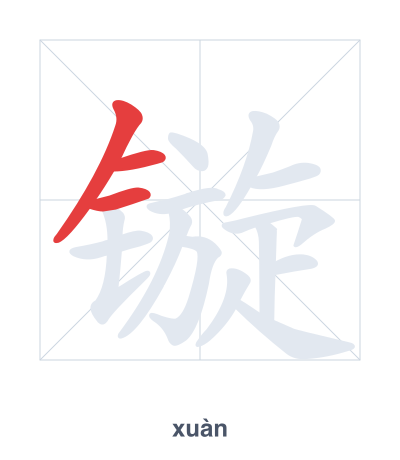
Open Hanzi Writer to see the animated stroke order and practice writing 镟 with real-time feedback.
The character 镟 (xuàn) is written with 16 strokes. Follow the standard Chinese stroke order: top to bottom, left to right, outside before inside. The radical 钅 is one of its key components.
Practice the correct stroke order with the Hanzi Writer app to see animated stroke-by-stroke guidance with real-time feedback.
镟 means to turn (on a lathe).
This character is a phono-semantic compound: the radical 钅 (metal) hints at a tool or metalworking, while the component 旋 (xuán, meaning 'to rotate' or 'whirl') provides the pronunciation and reinforces the turning action. Together, they depict a metal object being rotated on a lathe to shape it.
💡 Memory Tip: Imagine a metal rod (钅) spinning like a top (旋) as a lathe carves it smooth.
他在操作镟床。
tā zài cāo zuò xuàn chuáng
He is operating a lathe.
他是一名老镟工。
tā shì yī míng lǎo xuàn gōng
He is an experienced lathe operator.
金属正在被镟削。
jīn shǔ zhèng zài bèi xuàn xuē
The metal is being lathed.
Open Hanzi Writer to see the animated stroke order and practice writing 镟 with real-time feedback.
✨ Animated stroke order · Handwriting recognition · HSK-graded practice · Free to use
镟 is composed of the radical 钅 (metal) on the left and the character 旋 (xuán, meaning to rotate or spin) on the right. The metal radical indicates that the action involves a metal tool, while 旋 suggests the turning motion, so together they mean "to turn metal on a lathe."