猲 (xiē) means "short-haired dog (archaic)" in Chinese. It has 12 strokes with the radical 犭.
Rated 4.2/5 in difficulty (advanced).
Appears in 3+ common words including 猲猲 (xiē xiē), 猲狙 (xiē jū), 恐猲 (kǒng xiē).
Due to its 12 strokes, Hanzi Writer's error detection shows 猲 requires focused practice — most learners need 10+ attempts for consistent accuracy.
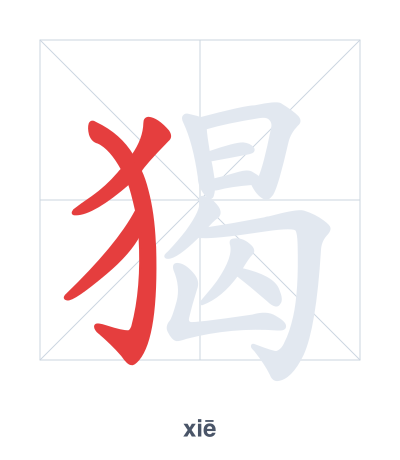
Open Hanzi Writer to see the animated stroke order and practice writing 猲 with real-time feedback.
The character 猲 (xiē) is written with 12 strokes. Follow the standard Chinese stroke order: top to bottom, left to right, outside before inside. The radical 犭 is one of its key components.
Practice the correct stroke order with the Hanzi Writer app to see animated stroke-by-stroke guidance with real-time feedback.
猲 means short-haired dog (archaic).
The character 猲 combines the radical 犭 (dog) on the left with 曷 (hé) on the right, which provides the sound. It originally referred to a short-haired dog, a specific breed noted in ancient texts. The 犭 component clearly indicates the canine family, while 曷 acts as a phonetic clue without contributing directly to the meaning.
💡 Memory Tip: Picture a dog (犭) with a short, bristly coat that looks like it's wearing a 'hat' (曷's top resembles a sun hat), and its name is 'Xiē' because it says 'sheesh' when you try to pet it.
这种动物叫猲猲。
zhè zhǒng dòng wù jiào xiē xiē
This animal is called a short-haired dog.
古书里提到了猲狙。
gǔ shū lǐ tí dào le xiē jū
Ancient books mentioned the Heju (a mythical beast).
他在恐猲别人。
tā zài kǒng xiē bié rén
He is intimidating others.
Open Hanzi Writer to see the animated stroke order and practice writing 猲 with real-time feedback.
✨ Animated stroke order · Handwriting recognition · HSK-graded practice · Free to use
The left side is the radical 犭, which means 'dog' or 'animal.' The right side is 曷 (hé), which provides pronunciation and originally meant 'why' or 'how' but here acts as a phonetic component. Together, the character refers to an archaic type of short-haired dog.