哓 (xiāo) means "To argue / To clamor" in Chinese. It has 9 strokes with the radical 口.
Rated 4/5 in difficulty (challenging).
Appears in 3+ common words including 哓哓 (xiāo xiāo), 哓舌 (xiāo shé), 晓哓 (xiǎo xiāo).
Due to its 9 strokes, Hanzi Writer's error detection shows 哓 requires focused practice — most learners need 10+ attempts for consistent accuracy.
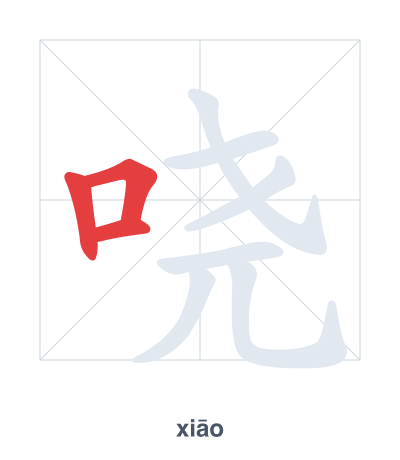
Open Hanzi Writer to see the animated stroke order and practice writing 哓 with real-time feedback.
The character 哓 (xiāo) is written with 9 strokes. Follow the standard Chinese stroke order: top to bottom, left to right, outside before inside. The radical 口 is one of its key components.
Practice the correct stroke order with the Hanzi Writer app to see animated stroke-by-stroke guidance with real-time feedback.
哓 means To argue / To clamor.
哓 is a phono-semantic compound combining the radical 口 (mouth) with 尧 (yáo) as a phonetic component. The mouth indicates speaking or noise, while 尧 originally meant 'high' but here provides the sound xiāo, together conveying the idea of loud arguing or clamoring.
💡 Memory Tip: Picture a mouth (口) arguing loudly with a person holding a spear (尧) – a noisy debate that clamors for attention.
他还在那儿哓哓不休。
tā hái zài nà ér xiāo xiāo bù xiū
He is still there arguing incessantly.
请不要在这里哓舌。
qǐng bú yào zài zhè lǐ xiāo shé
Please don't gossip here.
他说话晓哓动听。
tā shuō huà xiǎo xiāo dòng tīng
He speaks eloquently and pleasantly.
Open Hanzi Writer to see the animated stroke order and practice writing 哓 with real-time feedback.
✨ Animated stroke order · Handwriting recognition · HSK-graded practice · Free to use
哓 is composed of the radical 口 (mouth) on the left and 尧 (yáo, meaning 'high' or 'lofty') on the right. The mouth radical connects to speaking or vocalizing, while 尧 adds the sense of loudness or intensity, together forming the idea of arguing or clamoring loudly.