蟓 (xiàng) means "Weevil" in Chinese. It has 17 strokes with the radical 虫.
Rated 4.2/5 in difficulty (advanced).
Appears in 3+ common words including 蟓虫 (xiàng chóng), 蟓甲 (xiàng jiǎ), 象蟓 (xiàng xiàng).
Due to its 17 strokes, Hanzi Writer's error detection shows 蟓 requires focused practice — most learners need 10+ attempts for consistent accuracy.
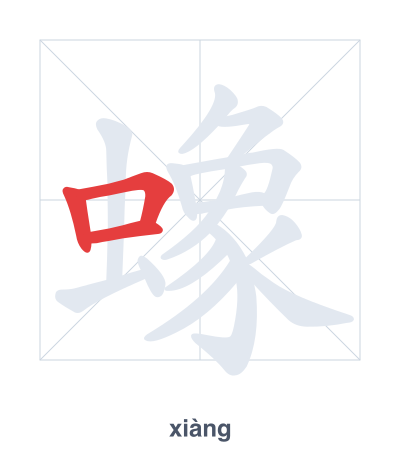
Open Hanzi Writer to see the animated stroke order and practice writing 蟓 with real-time feedback.
The character 蟓 (xiàng) is written with 17 strokes. Follow the standard Chinese stroke order: top to bottom, left to right, outside before inside. The radical 虫 is one of its key components.
Practice the correct stroke order with the Hanzi Writer app to see animated stroke-by-stroke guidance with real-time feedback.
蟓 means Weevil.
蟓 is a phono-semantic compound: the radical 虫 (insect) indicates it's a type of bug, while 象 (xiàng, elephant) provides the pronunciation and hints at the weevil's long snout, which resembles an elephant's trunk.
💡 Memory Tip: Imagine a tiny weevil wearing an elephant mask, its long trunk reaching out to munch on a leaf.
蟓虫会吃庄稼。
xiàng chóng huì chī zhuāng jià
Weevils eat crops.
这种虫子叫蟓甲。
zhè zhǒng chóng zi jiào xiàng jiǎ
This insect is called a weevil.
象蟓在树叶上。
xiàng xiàng zài shù yè shàng
The weevil is on the leaf.
Open Hanzi Writer to see the animated stroke order and practice writing 蟓 with real-time feedback.
✨ Animated stroke order · Handwriting recognition · HSK-graded practice · Free to use
The character 蟓 is composed of the radical 虫 (chóng, meaning insect) on the left and the phonetic component 象 (xiàng, meaning elephant) on the right. The radical indicates it is an insect type, while 象 hints at the pronunciation xiàng. The overall meaning is 'weevil,' a type of beetle.