Hanzi Writer

How to Write 俉 (wǔ) — Meaning “to meet or encounter (archaic)”

9 strokes Radical: 亻

俉 (wǔ) means "to meet or encounter (archaic)" in Chinese. It has 9 strokes with the radical 亻.

Rated 3.7/5 in difficulty (challenging).

Appears in 3+ common words including 俉见 (wǔ jiàn), 俉面 (wǔ miàn), 俉对 (wǔ duì).

Due to its 9 strokes, Hanzi Writer's error detection shows 俉 requires focused practice — most learners need 10+ attempts for consistent accuracy.
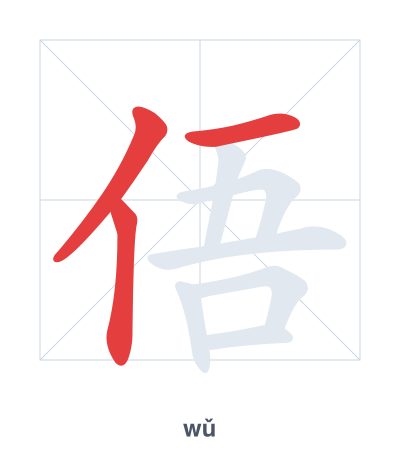
Stroke order practice for 俉 - wǔ

Practice Writing 俉 (wǔ)

Open Hanzi Writer to see the animated stroke order and practice writing 俉 with real-time feedback.

The character (wǔ) is written with 9 strokes. Follow the standard Chinese stroke order: top to bottom, left to right, outside before inside. The radical is one of its key components.

Practice the correct stroke order with the Hanzi Writer app to see animated stroke-by-stroke guidance with real-time feedback.

means to meet or encounter (archaic).

Character
Pinyinwǔ (wu)
Meaningto meet or encounter (archaic)
Strokes9
Radical
Difficulty3.7/5

俉 is a phono-semantic compound: the radical 亻 (person) suggests human interaction, while 吾 (wú, meaning 'I') adds pronunciation. The character's archaic meaning 'to meet or encounter' evokes two people coming face-to-face, as if one says 'I (吾) am here' upon meeting.

💡 Memory Tip: Imagine a person (亻) bumping into another while shouting '吾 (I)!' as a surprised greeting.

wǔ jiàn
to meet or see (archaic)
wǔ miàn
to meet face to face (archaic)
wǔ duì
to face or encounter (archaic)

我们好久没俉见了。

wǒ men hǎo jiǔ méi wǔ jiàn le

We haven't met for a long time.

两人在公园俉面。

liǎng rén zài gōng yuán wǔ miàn

The two met in the park.

请你和他俉对一下。

qǐng nǐ hé tā wǔ duì yī xià

Please check it with him.

Character Pinyin Strokes Radical
(current) 9
7
gū / gù 7
7
Stroke order practice for 俉 - wǔ

Practice Writing 俉 (wǔ)

Open Hanzi Writer to see the animated stroke order and practice writing 俉 with real-time feedback.

✨ Animated stroke order · Handwriting recognition · HSK-graded practice · Free to use

Frequently Asked Questions about 俉

俉 is composed of the radical 亻 (person) on the left and 吾 (wú, meaning 'I' or 'my') on the right. The person radical indicates human action, while 吾 provides the sound; together they suggest a person encountering someone, matching the archaic meaning 'to meet or encounter.'

Characters with Radical 亻

Other 9-Stroke Characters