猬 (wèi) means "hedgehog" in Chinese. It has 12 strokes with the radical 犭.
Rated 4.2/5 in difficulty (advanced).
Appears in 3+ common words including 刺猬 (cì wèi), 猬集 (wèi jí), 刺猬头 (cì wèi tóu).
Due to its 12 strokes, Hanzi Writer's error detection shows 猬 requires focused practice — most learners need 10+ attempts for consistent accuracy.
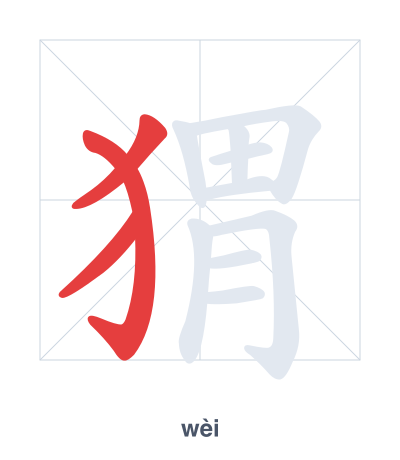
Open Hanzi Writer to see the animated stroke order and practice writing 猬 with real-time feedback.
The character 猬 (wèi) is written with 12 strokes. Follow the standard Chinese stroke order: top to bottom, left to right, outside before inside. The radical 犭 is one of its key components.
Practice the correct stroke order with the Hanzi Writer app to see animated stroke-by-stroke guidance with real-time feedback.
猬 means hedgehog.
猬 is a phono-semantic compound: the radical 犭 (animal) indicates it's a beast, while the right side 胃 (stomach, pronounced wèi) provides the sound. The hedgehog's habit of curling into a tight, round ball may have suggested a visual link to a stomach-like shape.
💡 Memory Tip: Imagine a hedgehog with a spiky stomach (胃) that curls up into a ball to protect itself.
草丛里有一只刺猬。
cǎo cóng lǐ yǒu yī zhī cì wèi
There is a hedgehog in the grass.
事情猬集在一起。
shì qíng wèi jí zài yì qǐ
Many things are crowding together at once.
他的发型是刺猬头。
tā de fà xíng shì cì wèi tóu
His hairstyle is a spiky cut.
Open Hanzi Writer to see the animated stroke order and practice writing 猬 with real-time feedback.
✨ Animated stroke order · Handwriting recognition · HSK-graded practice · Free to use
猬 is made of the radical 犭 (animal) on the left and 胃 (stomach) on the right. The radical tells us the character refers to an animal, and 胃 provides the pronunciation (wèi). Together they form the word for hedgehog, a small animal with spines.