娓 (wěi) means "tireless" in Chinese. It has 10 strokes with the radical 女.
Rated 4.2/5 in difficulty (advanced).
Appears in 3+ common words including 娓娓 (wěi wěi), 娓娓动听 (wěi wěi dòng tīng), 娓娓而谈 (wěi wěi ér tán).
Due to its 10 strokes, Hanzi Writer's error detection shows 娓 requires focused practice — most learners need 10+ attempts for consistent accuracy.
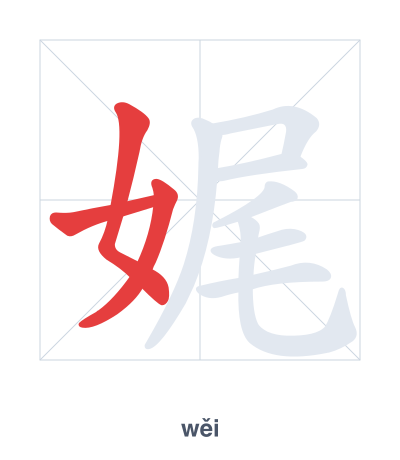
Open Hanzi Writer to see the animated stroke order and practice writing 娓 with real-time feedback.
The character 娓 (wěi) is written with 10 strokes. Follow the standard Chinese stroke order: top to bottom, left to right, outside before inside. The radical 女 is one of its key components.
Practice the correct stroke order with the Hanzi Writer app to see animated stroke-by-stroke guidance with real-time feedback.
娓 means tireless.
娓 is a phono-semantic compound with 女 (woman) as the radical and 尾 (tail) as the phonetic. The meaning 'tireless' comes from its use in the reduplicated form 娓娓, which originally described endless, flowing talk—like a woman's chatter that never tires, much like a tail that keeps wagging without stopping.
💡 Memory Tip: Picture a tireless woman (女) whose chattering tail (尾) never stops wagging, no matter how long she talks.
他娓娓道来。
tā wěi wěi dào lái
He spoke eloquently and engagingly.
他的故事娓娓动听。
tā de gù shì wěi wěi dòng tīng
His story is told vividly and pleasingly.
老师在娓娓而谈。
lǎo shī zài wěi wěi ér tán
The teacher is talking eloquently.
Open Hanzi Writer to see the animated stroke order and practice writing 娓 with real-time feedback.
✨ Animated stroke order · Handwriting recognition · HSK-graded practice · Free to use
娓 is composed of the radical 女 (woman) on the left and the character 尾 (tail) on the right. The 尾 component provides the pronunciation wěi, while the 女 radical hints at speech or behavior commonly associated with women. Together they form a character that means 'tireless,' especially in the context of talking or narrating.