崴 (wǎi) means "To sprain / uneven" in Chinese. It has 12 strokes with the radical 山.
Rated 4.2/5 in difficulty (advanced).
Appears in 3+ common words including 崴脚 (wǎi jiǎo), 崴了 (wǎi le), 走崴了 (zǒu wǎi le).
Due to its 12 strokes, Hanzi Writer's error detection shows 崴 requires focused practice — most learners need 10+ attempts for consistent accuracy.
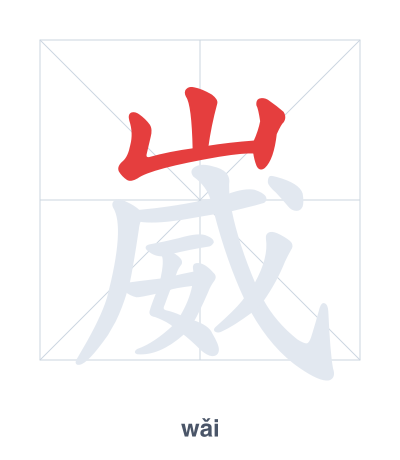
Open Hanzi Writer to see the animated stroke order and practice writing 崴 with real-time feedback.
The character 崴 (wǎi) is written with 12 strokes. Follow the standard Chinese stroke order: top to bottom, left to right, outside before inside. The radical 山 is one of its key components.
Practice the correct stroke order with the Hanzi Writer app to see animated stroke-by-stroke guidance with real-time feedback.
崴 means To sprain / uneven.
崴 combines the mountain radical 山 with 威 (majestic, dangerous), suggesting rugged, uneven mountain terrain where one might easily sprain an ankle. The visual form thus directly links the idea of unevenness and injury to a hazardous landscape.
💡 Memory Tip: Picture hiking a mountain (山) and stepping on a spear (戈) dropped by a woman (女) — you sprain your ankle (崴).
跑步时不要崴脚。
pǎo bù shí bú yào wǎi jiǎo
Don't sprain your ankle while running.
我的脚崴了。
wǒ de jiǎo wǎi le
I sprained my ankle.
他走路走崴了。
tā zǒu lù zǒu wǎi le
He sprained his ankle while walking.
Open Hanzi Writer to see the animated stroke order and practice writing 崴 with real-time feedback.
✨ Animated stroke order · Handwriting recognition · HSK-graded practice · Free to use
崴 is made of the radical 山 (mountain) on top and the phonetic component 威 below. The mountain radical hints at uneven terrain, which is the kind of ground that can cause you to sprain your ankle. The sound part 威 gives the character its pronunciation wǎi.