Hanzi Writer

How to Write 趯 (tì) — Meaning “to jump; (calligraphy) a hook stroke”

21 strokes Radical: 走

趯 (tì) means "to jump; (calligraphy) a hook stroke" in Chinese. It has 21 strokes with the radical 走.

Rated 4.2/5 in difficulty (advanced).

Appears in 3+ common words including 趯然 (tì rán), 趯跳 (tì tiào), 趯起 (tì qǐ).

Due to its 21 strokes, Hanzi Writer's error detection shows 趯 requires focused practice — most learners need 10+ attempts for consistent accuracy.
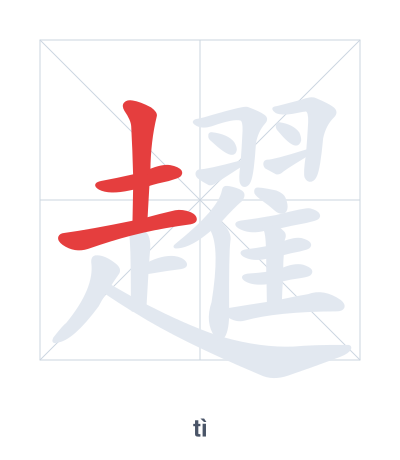
Stroke order practice for 趯 - tì

Practice Writing 趯 (tì)

Open Hanzi Writer to see the animated stroke order and practice writing 趯 with real-time feedback.

The character (tì) is written with 21 strokes. Follow the standard Chinese stroke order: top to bottom, left to right, outside before inside. The radical is one of its key components.

Practice the correct stroke order with the Hanzi Writer app to see animated stroke-by-stroke guidance with real-time feedback.

means to jump; (calligraphy) a hook stroke.

Character
Pinyintì (ti)
Meaningto jump; (calligraphy) a hook stroke
Strokes21
Radical
Difficulty4.2/5

趯 combines the radical 走 (walk/run) with 翟, which depicts a long-tailed pheasant. The pheasant's quick, leaping motion inspired the meaning 'to jump,' while in calligraphy the character refers to a hook stroke—a rapid upward flick resembling a bird's sudden hop.

💡 Memory Tip: Picture a running figure (走) who suddenly springs into a hook-like leap, with feathers (羽) and a bird (隹) flapping behind for extra lift.

tì rán
jumping; leaping
tì tiào
to jump; to leap
tì qǐ
to kick up; to jump up

他的心趯然一跳。

tā de xīn tì rán yī tiào

His heart gave a sudden throb.

虫子在地上趯跳。

chóng zi zài dì shàng tì tiào

The insect is hopping on the ground.

他趯起脚尖看。

tā tì qǐ jiǎo jiān kàn

He stood on tiptoe to look.

Character Pinyin Strokes Radical
(current) 21
zǎn 23
Stroke order practice for 趯 - tì

Practice Writing 趯 (tì)

Open Hanzi Writer to see the animated stroke order and practice writing 趯 with real-time feedback.

✨ Animated stroke order · Handwriting recognition · HSK-graded practice · Free to use

Frequently Asked Questions about 趯

The character 趯 is composed of the radical 走 (to walk) on the left and the phonetic component 翟 (dí, a pheasant) on the right. The 走 radical suggests movement like jumping, while 翟 provides the pronunciation tì and also hints at a bird's leaping action.

Characters with Radical 走

Other 21-Stroke Characters