唐 (táng) means "Tang Dynasty or Chinese." in Chinese. It has 10 strokes with the radical 口.
Rated 4.2/5 in difficulty (advanced).
Appears in 3+ common words including 唐人街 (táng rén jiē), 唐装 (táng zhuāng), 唐朝 (táng cháo).
Due to its 10 strokes, Hanzi Writer's error detection shows 唐 requires focused practice — most learners need 10+ attempts for consistent accuracy.
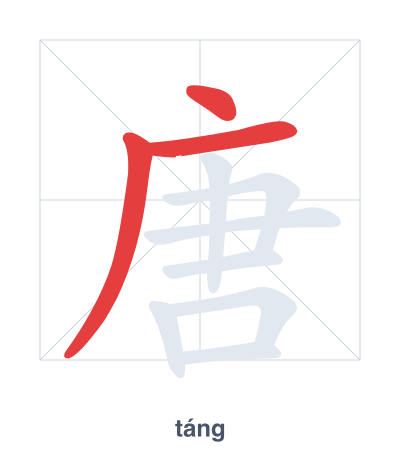
Open Hanzi Writer to see the animated stroke order and practice writing 唐 with real-time feedback.
The character 唐 (táng) is written with 10 strokes. Follow the standard Chinese stroke order: top to bottom, left to right, outside before inside. The radical 口 is one of its key components.
Practice the correct stroke order with the Hanzi Writer app to see animated stroke-by-stroke guidance with real-time feedback.
唐 means Tang Dynasty or Chinese..
唐 is a compound character with 口 (mouth/speech) as the radical, suggesting speech or proclamation. The phonetic component 庚 originally depicted a mortar with a pestle, and together the character meant 'boastful talk' or 'to exaggerate.' Later it was borrowed to represent the glorious Tang Dynasty, a golden age of Chinese culture and power.
💡 Memory Tip: Picture a mouth (口) under a grand roof (广) where the Tang emperor announces a new decree, symbolizing the dynasty's authority and prosperity.
唐人街有很多菜。
táng rén jiē yǒu hěn duō cài
There are many dishes in Chinatown.
他穿着一件唐装。
tā chuān zhe yī jiàn táng zhuāng
He is wearing a Tang suit.
唐朝很有名。
táng cháo hěn yǒu míng
The Tang Dynasty is very famous.
Open Hanzi Writer to see the animated stroke order and practice writing 唐 with real-time feedback.
✨ Animated stroke order · Handwriting recognition · HSK-graded practice · Free to use
唐 is made of the radical 口 (mouth) on the outside and 肀 (a phonetic component) inside. The radical 口 suggests speaking or naming, linking to the idea of the Tang Dynasty as a great empire known for its culture and language. The whole character represents the dynasty's name, which later also came to mean 'Chinese' in certain contexts.