炭 (tàn) means "Charcoal" in Chinese. It has 9 strokes with the radical 火, and is HSK Level 7.
Rated 3.7/5 in difficulty (challenging).
Harder than 29% of HSK Level 7 characters.
Appears in 3+ common words including 木炭 (mù tàn), 木炭画 (mù tàn huà), 烧炭 (shāo tàn).
Due to its 9 strokes, Hanzi Writer's error detection shows 炭 requires focused practice — most learners need 10+ attempts for consistent accuracy.
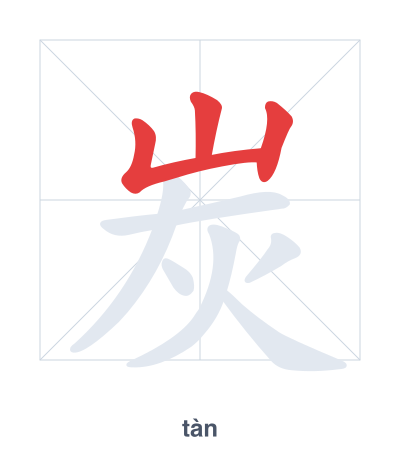
Open Hanzi Writer to see the animated stroke order and practice writing 炭 with real-time feedback.
The character 炭 (tàn) is written with 9 strokes. Follow the standard Chinese stroke order: top to bottom, left to right, outside before inside. The radical 火 is one of its key components.
Practice the correct stroke order with the Hanzi Writer app to see animated stroke-by-stroke guidance with real-time feedback.
炭 means Charcoal.
As an HSK Level 7 character, 炭 is an intermediate-level character.
炭 combines 山 (mountain) and 火 (fire), illustrating charcoal produced by burning wood in a mountain kiln. The top component represents the mountain or pit where wood is stacked, while the bottom shows the fire that transforms it into charcoal.
💡 Memory Tip: Picture a mountain (山) on fire (火) to remember that charcoal is made by burning wood in a mountain kiln.
我们买了一些木炭。
wǒ men mǎi le yī xiē mù tàn
We bought some charcoal.
他在画木炭画。
tā zài huà mù tàn huà
He is drawing a charcoal sketch.
冬天要烧炭取暖。
dōng tiān yào shāo tàn qǔ nuǎn
Charcoal is burned for warmth in winter.
Open Hanzi Writer to see the animated stroke order and practice writing 炭 with real-time feedback.
✨ Animated stroke order · Handwriting recognition · HSK-graded practice · Free to use
炭 consists of the radical 火 (fire) on top and 冐 (a variant of 山, mountain) below. The character shows charcoal as a product of burning wood, combining fire and mountain (a place where charcoal was historically made). This structure visually represents charcoal as something that comes from fire and earth.