漯 (tà) means "Luo (river name)" in Chinese. It has 14 strokes with the radical 氵.
Rated 4.2/5 in difficulty (advanced).
Appears in 3+ common words including 漯河 (tà hé), 漯河人 (tà hé rén), 去漯河 (qù tà hé).
Due to its 14 strokes, Hanzi Writer's error detection shows 漯 requires focused practice — most learners need 10+ attempts for consistent accuracy.
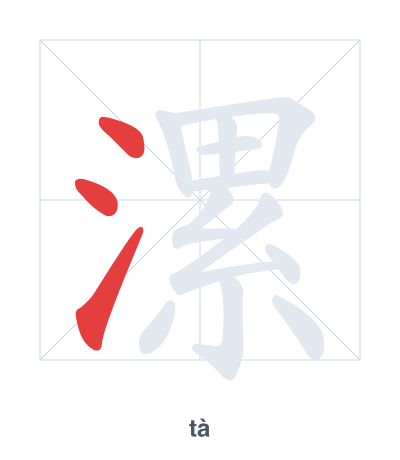
Open Hanzi Writer to see the animated stroke order and practice writing 漯 with real-time feedback.
The character 漯 (tà) is written with 14 strokes. Follow the standard Chinese stroke order: top to bottom, left to right, outside before inside. The radical 氵 is one of its key components.
Practice the correct stroke order with the Hanzi Writer app to see animated stroke-by-stroke guidance with real-time feedback.
漯 means Luo (river name).
漯 is a phono-semantic compound. The water radical (氵) indicates it relates to a river, while 累 (léi) originally contributed to the pronunciation (though the modern reading is tà). This character specifically names the Luo River (漯河) in Henan province, China.
💡 Memory Tip: Picture a river (氵) where a pile of stacked bricks (累) dams the water, creating the winding Luo River.
他住在漯河市。
tā zhù zài tà hé shì
He lives in Luohe City.
他是漯河人。
tā shì tà hé rén
He is from Luohe.
我们要去漯河。
wǒ men yào qù tà hé
We are going to Luohe.
Open Hanzi Writer to see the animated stroke order and practice writing 漯 with real-time feedback.
✨ Animated stroke order · Handwriting recognition · HSK-graded practice · Free to use
漯 has the water radical 氵 on the left, showing it is related to a river or water. The right side is 累, which originally provided the sound (though not exact today). Together, 漯 means the Luo River, a specific river name.