Hanzi Writer

How to Write 榻 (tà) — Meaning “Couch or bed”

14 strokes Radical: 木

榻 (tà) means "Couch or bed" in Chinese. It has 14 strokes with the radical 木.

Rated 4.2/5 in difficulty (advanced).

Appears in 3+ common words including 榻榻米 (tà tà mǐ), 下榻 (xià tà), 卧榻 (wò tà).

Due to its 14 strokes, Hanzi Writer's error detection shows 榻 requires focused practice — most learners need 10+ attempts for consistent accuracy.
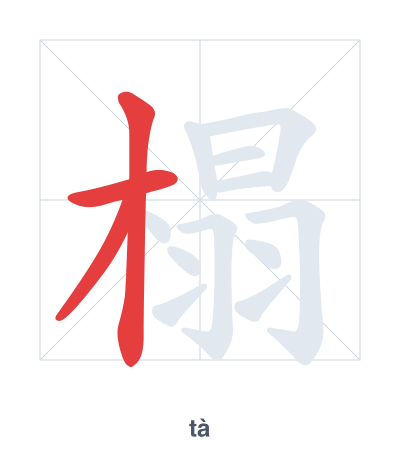
Stroke order practice for 榻 - tà

Practice Writing 榻 (tà)

Open Hanzi Writer to see the animated stroke order and practice writing 榻 with real-time feedback.

The character (tà) is written with 14 strokes. Follow the standard Chinese stroke order: top to bottom, left to right, outside before inside. The radical is one of its key components.

Practice the correct stroke order with the Hanzi Writer app to see animated stroke-by-stroke guidance with real-time feedback.

means Couch or bed.

Character
Pinyintà (ta)
MeaningCouch or bed
Strokes14
Radical
Difficulty4.2/5

榻 (tà) is a phono-semantic compound: the radical 木 (wood) indicates the material, and the component 沓 (tà) provides the sound. It originally referred to a low wooden couch or bed commonly used in ancient China for sitting or sleeping.

💡 Memory Tip: Picture a wooden couch (木) with a net (罒) draped over a sun (日) pattern — a perfect spot to lie down and repeat (沓) your lazy afternoon dreams.

tà tà mǐ
Tatami
xià tà
to stay (at a hotel or lodging)
wò tà
couch / bed

房间里有榻榻米。

fáng jiān lǐ yǒu tà tà mǐ

There are tatami mats in the room.

贵宾已经安排下榻。

guì bīn yǐ jīng ān pái xià tà

The VIPs have been arranged to stay.

他躺在卧榻上休息。

tā tǎng zài wò tà shàng xiū xī

He is resting on the couch.

Character Pinyin Strokes Radical
(current) 14
mián 12
12
gùn 12
Stroke order practice for 榻 - tà

Practice Writing 榻 (tà)

Open Hanzi Writer to see the animated stroke order and practice writing 榻 with real-time feedback.

✨ Animated stroke order · Handwriting recognition · HSK-graded practice · Free to use

Frequently Asked Questions about 榻

榻 combines the radical 木 (wood) on the left, suggesting it is made of wood, with the phonetic component 㕇 (tà) on the right. Since traditional Chinese couches and beds were often wooden frames, the wood radical directly hints at the character's meaning of "couch" or "bed."

Characters with Radical 木

Other 14-Stroke Characters